
Master of the Schwartzenberg Portraits
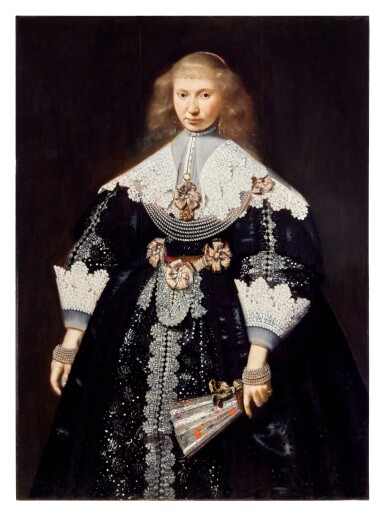
Portrait of a Lady Holding a Fan
Live auction begins on:
February 6, 03:00 PM GMT
Estimate
80,000 - 120,000 USD
Bid
55,000 USD
Lot Details
Description
Master of the Schwartzenberg Portraits
active in Friesland circa 1638 - 1646
Portrait of a Young Lady Holding a Fan
oil on panel
panel: 45 ½ by 33 in.; 115.6 by 83.8 cm
framed: 54 ½ by 42 in.; 138.4 by 106.7 cm
Arthur Sanderson, London, Edinburgh;
His sale, Knight, London, Frank & Rutley, 14 June 1911, lot 607 (as Dirk van Santvoort);
Where acquired by "Cohen";
Anonymous sale, Bruges, Carlo Bonte Auctions, 18 February 2021, lot 5 (as Attributed to Dirck Dircksz. Santvoort);
Where acquired by the present owner.
Dated to circa 1638, this refined portrait is a work by the Master of the Schwartzenberg Portraits, an anonymous but distinctive artist active in Frisia and closely associated with the circle of Wybrand de Geest, under whom he may have trained.1 The master is best known for a small, refined group of aristocratic and patrician portraits, including the likeness of Maria thoe Schwartzenberg in the Fries Museum, Leeuwarden (inv. no. S1980-239). The attribution of the present work has been kindly suggested by Rudi Ekkart and Claire van den Donk, and it stands as a compelling example of the ambition and sophistication of Frisian portraiture at the height of the Dutch Golden Age.2
The present portrait depicts a young woman in the established tradition of the martial portrait, indicated by the ring suspended from the chain around her neck. She is richly dressed in a black gown embroidered with silver thread, offset by crisp white lace at the collar and cuffs and animated by silk rosettes at the bodice. Multiple strands of pearls—worn at her neck and wrists—underscore her wealth and status, pearls having supplanted gold chains as the preferred adornment among the Dutch elite by the late 1630s. In her right hand she holds a folding fan, a fashionable accessory frequently included in female portraiture of the period and emblematic of refinement and modern taste.
The emphasis on the sitter's luxurious costume places the work within the highest tradition of Dutch bourgeois portraiture. The attire may be compared with the sumptuous black-and-white costume in Rembrandt van Rijn’s celebrated Portrait of Agatha Bas (1641) in the Royal Collection at Buckingham Palace, London (inv. no. 405352), where the dramatic articulation of lace, pearls, and fan similarly serves to project social authority and feminine virtue. In both works, the costume becomes a vehicle for presence, asserting the sitter’s identity within a tightly codified social hierarchy.
1 Master of the Schwartzenberg Portraits was a provisional name assigned by A. Wassenbergh to the painter of eight unsigned but stylistically related portraits, among which are portraits of the family Thoe Scwartzenberg en Hohenlangsberg. See: A/ Wassenbergh, De portretkunst in Friesland in de zeventiende eeuw, Lochem 1967, pp. 40-41.
2 On 28 September 2021, after first-hand inspection (according to the present owner).
You May Also Like


