
Property from a Connecticut Collection
Antwerp School, 17th century
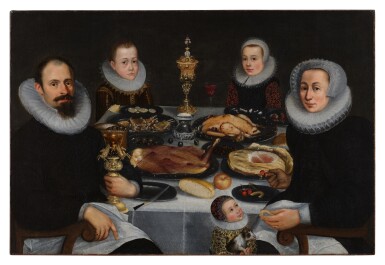
Family Portrait, Possibly of Andres Dias, Margarethe Essers, and Their Three Children, at a Dinner Table
Live auction begins on:
February 6, 03:00 PM GMT
Estimate
150,000 - 200,000 USD
Bid
110,000 USD
Lot Details
Description
Property from a Connecticut Collection
Antwerp School, 17th century
Family Portrait, Possibly of Andres Dias, Margarethe Essers, and Their Three Children, at a Dinner Table
inscribed with unidentified monogram and coat of arms on the knife blade
oil on canvas
canvas: 40 by 60 ⅛ in.; 101.6 by 152.7 cm
framed: 47 ½ by 68 in.; 120.6 by 172.7 cm
Collection of the sitters, Andres Dias and Margarethe Essers;
Thence by inheritance in the Van der Kun family, Den Burch, Rijswijk, The Netherlands;
With Theo Daatselaar Antiquairs B.V., Utrecht;
From whom acquired by the present collector, 2023.
's-Hertogenbosch, Noordbrabants Museum, A la c'Arte: The Art of Food - Food in Art, 18 September 2010 - 2 January 2011, no. 7 (lent by Theo Daatselaar Antiquairs).
F. Zachariasse and P. Viskil (eds.), A la c'Arte, exhibition catalogue, Amsterdam 2010, p. 14, cat. no. 7, reproduced (as Dutch School, circa 1610).
This impressive portrait of a patrician family gathered around a richly laden table can be dated to circa 1620 and represents a rare example within seventeenth-century portraiture. Family portraits staged around a dining table are highly unusual, with only a handful of comparable examples known from the period. The present work is further distinguished by its remarkable provenance, having apparently descended within the family of the sitters for centuries, a testament to its significance as both a dynastic image and a cherished heirloom.
The husband and wife occupy the foreground, asserting their status as heads of the household. The father raises a berkemeier mounted on a bekerschroef, a confident gesture of hospitality and authority, while his wife delicately holds two cherries and a broken krakeling. The sumptuous display of food and objects—roast fowl, cured meats, sweetmeats, olives, citrus fruits, and costly salt—signals the family’s prosperity and engagement with international trade. Such luxury goods, imported from distant regions, were potent markers of wealth in early seventeenth-century Antwerp. The sitters’ attire, embellished with fine lace and gilt-thread embroidery, reinforces this impression, underscoring the painting’s function as a deliberate showpiece and source of familial pride.
The sitters are thought to be Andreas (Andries) Dias, of Portuguese descent, his wife Margaretha Essers, and their three children: Gaspar, Magdalena (born 1613), and Emerentiana (born 1615). Dias enjoyed considerable social standing in Antwerp: he was a vassal of the Viscountship of Antwerp, owned a burial vault in the Predikherenkloster, and appears to have been active as a commodities broker on the Antwerp stock exchange, a profession later shared by his son. Yet his primary trade was that of a master embroiderer (bourduerwercker). Apprenticed in 1605 and admitted as a master in 1609, Dias was a member of the Antwerp Guild of Saint Luke, and his gesture toward the embroidered tablecloth in the painting may be read as a proud allusion to his profession.
Several motifs carry pointed symbolic and biographical resonance in this distinguished family portrait. The orange placed prominently on the table was, at the beginning of the seventeenth century, a product exported by Portuguese merchants to northern Europe, serving here as both a sign of affluence and a subtle reference to the family’s Portuguese roots. Other exotic elements—the lemon, olives, and the guinea pig cradled by the youngest child—likewise evoke Mediterranean trade and global exchange. The guinea pig is especially noteworthy, appearing to be among the earliest representations of this animal as a household pet in European portraiture. The knife blade resting on the father’s plate is engraved with a coat of arms surmounted by a star or comet, which may allude to the family name Dias (or Diez), with the star functioning as a visual pun on “day” (“dies” in Latin).
The handling of the lavish still-life elements suggests that the artist, or artists, responsible for the painting were closely familiar with work of contemporary Antwerp still-life specialists Osias Beert and Clara Peeters. The carefully arranged table recalls the refined banquet pieces produced in Antwerp in the first decades of the century. Given Dias’s membership in the Guild of Saint Luke, he may have moved within the same artistic circles as these painters. Further underscoring the family’s artistic milieu, a relative of the children later married into the family of Anthony van Dyck.
Until recently, the painting remained with the prosperous van der Kun (Cun/Cunne) family, descendants of the sitters, who were established wine buyers from the seventeenth century onward and held prominent civic and charitable positions. The work is said to have hung in one of their estates, Den Burch in Rijswijk. Combining portraiture, still life, and subtle self-fashioning, this exceptional painting offers a vivid insight into the prosperous patrician class in early seventeenth-century Antwerp.
You May Also Like


