
François-Marius Granet
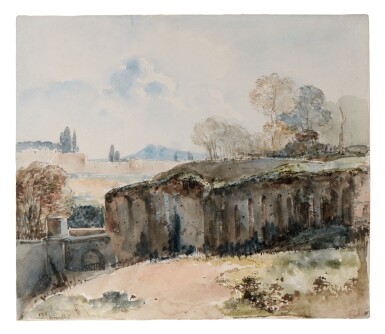
View in the Castelli Romani
Estimate
12,000 - 18,000 USD
Lot Details
Description
François-Marius Granet
(Aix-en-Provence 1775 – 1849)
View in the Castelli Romani
Pen and brown ink and watercolor over graphite;
inscribed in graphite, lower left: Roma
bears numbering in brown ink, lower left: 136.
and bears an old attribution in brown ink, lower left: Bénouville f.
208 by 242 mm; 8¼ by 9½ in.
The artist’s estate, with the paraphe of Granet’s co-executor, Jean-François Legendre-Héral and his numbering: 136;
Private collection;
sale, Paris, Ader Picart & Tajan, 1999 (as Benouville), according to Fiertag,
with Neal Fiertag, Paris, 2000,
where acquired by Diane A. Nixon
New York, The Morgan Library & Museum; Washington, D.C., National Gallery of Art, Private Treasures: Four Centuries of European Master Drawings, 2007, no. 80 (entry by Jennifer Tonkovich);
Northampton, Massachusetts, Smith College Museum of Art; Ithaca, New York, Herbert F. Johnson Museum of Art, Drawn to Excellence: Renaissance to Romantic Drawings from a Private Collection, 2012-2013, no. 82
François-Marius Granet was a pupil of Jean-Antoine Constantin (1756-1844) and he also trained for a brief period in the studio of Jacques-Louis David (1748-1825). In 1802 he travelled to Rome where he lived for nearly thirty years, carving out a successful artistic career which, among other commissions, included selling views of Rome to local collectors and foreign tourists alike. On his return to France in 1830 he assumed a post as a curator at the Musée du Louvre and subsequently, some three years later, was appointed as the first curator of the Musée Historique, Versailles.
The present watercolor belongs to a small group of sheets executed during the artist’s time in Rome, when he first began to experiment with the medium. The site depicted has been tentatively identified as a view of the Monte Cavo from Frascati. A significantly later drawing1 by the British artist Gilbert Ledward (1888-1960) annotated by the artist with the location – Monte Cavo from Frascati – illustrates clearly the compelling topographical similarities of the mountain on the horizon of the Nixon drawing. Granet was also known to make regular trips through the castelli romani and a comparable sheet to the present lot, of identical dimensions, can be found in the Musée Granet depicting a Vue des Quatre-Saints-Couronnés, de Saint Jean de Latran depuis les ruines des thermes de Titus.2
Curiously the attribution of this beautifully preserved watercolor seems to have previously been lost, as it bears an old attribution to Benouville, probably Jean-Achille Benouville (1815-1891), in the lower left corner. There is a certain irony, therefore, that this erroneous attribution should sit alongside the wiry paraph of Jean-François Legendre-Héral (1796-1851) who was the co-executor of Granet’s will and who applied his paraphe to the drawings in Granet’s studio at the time of the artist’s death.3
1.London, Royal Academy, inv. no. 10/3707
2.See D. Coutagne, François-Marius Granet, 1775-1849 une vie pour la peinture, exhib. cat., Aix-en-Provence, Musée Granet, 2008, p. 154, n. 130, reproduced fig. 130
3.Denis Coutagne, previous director of the Musée Granet, Aix-en-Provence, affirmed the attribution of the Nixon drawing to Granet and the authenticity of the inscriptions in a written correspondence of 24 September 2004.
You May Also Like


