
Jacques Jordaens
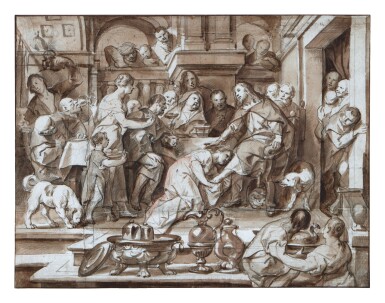
Mary Magdalen Anointing Christ's Feet
Estimate
50,000 - 70,000 USD
Lot Details
Description
Jacques Jordaens
(Antwerp 1593 - 1678)
Mary Magdalen Anointing Christ's Feet
Pen and brown ink and wash with touches of red chalk, over black chalk, on three joined sheets of paper, within brown ink framing lines;
inscribed in black chalk, top center: Joan 12 (?);
bears inscriptions, verso, in brown ink: de Subreesan Tor Tapesserye. Een Resried (?) Gran Carolus Magnus Billeg (?) (top left, inverted), and Jordaans Opgetekend (?) door de Wit, and numbering, in graphite, verso, lower right: 204C
302 by 394 mm; 11⅞ by 15½ in.
Probably Jacob de Wit (1695-1754), Amsterdam;
Rouit-Berger Collection, Paris,
sale, Paris, Hôtel Drouot, 28 November 1934, lot 99 (reproduced pl. VI);
Private Collection, France;
sale, Paris, Neret-Minet, 15 November 1999, lot 39 (as Studio of Jacob Jordaens);
with Thos. Agnew and Sons, Ltd., London, 1999,
where acquired by Diane A. Nixon
New York, The Morgan Library & Museum; Washington, D.C., National Gallery of Art, Private Treasures: Four Centuries of European Master Drawings, 2007, no. 38 (entry by Stacey Sell)
L. Van Puyvelde, Jordaens, Paris and Brussels 1953, p. 191;
R.-A. d'Hulst, Jordaens Drawings, 4 vols., London and New York 1974, vol. 2, p. 374, no. A298 (as Christ in the House of Simon the Pharisee), reproduced vol. 4, fig. 315
Jordaens was one of the most productive Flemish artists of the 17th century, running a highly successful workshop that produced paintings, designed tapestries, and engaged in many other artistic activities. Following the death of his former teacher, Peter Paul Rubens (1577-1640), Jordaens was widely considered the leading artist working in Antwerp, a position he held until his own death, nearly four decades later.
Although no other work based on this drawing is known, it was most likely made as a design for a tapestry. Its elaborate composition, composed of many figures distributed across the entire scene, would have been especially well suited to a work of that type, and this also seems to have been the reaction of the early owner of the drawing whose (partially illegible) inscription on the verso refers in some way to tapestry.1 Very likely, such a tapestry would have been one of a series representing similar subjects, and Roger d’Hulst has in fact identified two more drawings, very similar to this in dimensions and technique, depicting the loosely related subjects of Christ and the Pharisees and The Widow’s Mite, which he feels could well have been made in connection with the same project.2
In the earlier part of Jordaens’ career, his designs for tapestries were often worked up with bright watercolors and even some gouache, but later he tended to work more in monochrome when making his designs, and the rapid, loose handling seen here is also typical of his works from the 1650s. One common feature, though, of his tapestry designs from all periods is that he frequently altered the format of his drawing, sometimes very radically, adding further sections of paper to allow him to extend the composition, or even in some cases cutting the drawing in half and inserting an additional strip in between the two original parts.3 In the Nixon drawing, the design originally ended on the left just behind the child, and at the bottom just below the central kneeling figure of Mary; the two figures and the dog to the left of the composition are additions, drawn on a separate piece of paper, as is the entire foreground, with its lavish still life element and further figures. Clearly, Jordaens ultimately felt the need to make his design considerably more flamboyant than he had at first envisaged.
Were it not for the kneeling female figure in the foreground, the subject of this drawing might have been thought to be a secular banquet, but it is faintly inscribed at the top with a reference to John 12, the biblical text describing the Anointing at Bethany. In this episode Christ is visiting the house of Mary, Martha and Lazarus, and while Martha serves a meal, Mary anoints Christ’s feet with costly oil. Judas Iscariot criticises Mary for wasting the oil, saying she should have sold it and given the money to the poor, but Christ stops him, pointing out that the poor will always be there, but that he will one day be gone. Previously, the subject had been identified as Christ’s visit to the house of Simon the Pharisee (Luke 7:36), but the details of Jordaens’ composition appear to fit better with the aforementioned subject from St. John’s Gospel.
Finally, it should be noted that a second inscription on the verso, in an eighteenth-century hand, states that the drawing is by Jordaens, ‘opgetekent’ (i.e. finished, or worked up) by De Wit (i.e. Jacob de Wit (1695-1754)). The elaborating in the eighteenth century of earlier drawings in order to make them seem more complete, was very common, and not thought of as in any way inappropriate, but all the same, the handling throughout the present drawing seems both internally consistent and typical of Jordaens, and there is no sign that another hand has intervened in the drawing.4 Perhaps it was simply inconceivable to the eighteenth-century collector that a seventeenth-century drawing could be so freely drawn and extensively worked up without the intervention of a later hand.
1. For a full account of Jordaens’ activity in this field, see K. Nelson, Jacob Jordaens, Design for Tapestry, Turnhout 1989
2. Respectively: whereabouts unknown, d’Hulst, op. cit., no. A296; and Worms, Kunsthaus Heylshof, d’Hulst, op. cit., no. A297
3. See, for example, A Merry Company (an Allegory of Integrity), sold, Amsterdam, Sotheby’s, 5 November 2002, lot 25
4. For a revealing analysis of a drawing by Jordaens that actually does seem to be retouched by Jacob de Wit, now in Weimar (Kunstsammlungen zu Weimar, inv. KK 5067), see R.J.A. te Rijdt, 'Jacob Jordaens (1593-1678) en Jacob de Wit (1695-1754)', Delineavit et Sculpsit, 23 (July 2001), pp. 34-37, reproduced p. 33, fig. 4
You May Also Like


