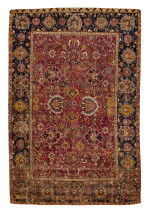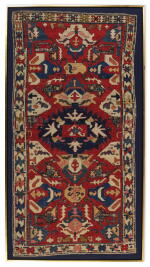
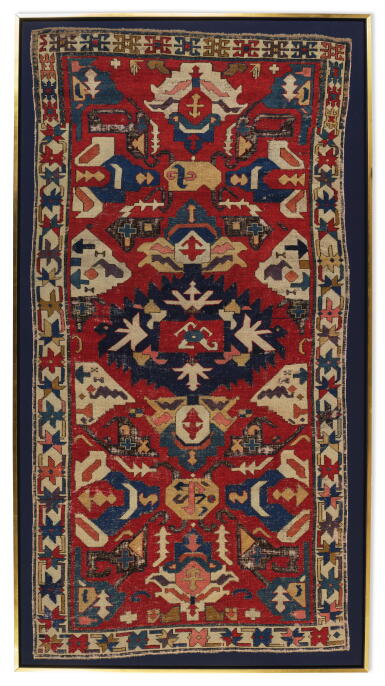
A Caucasian Rug, Late 17th Century
Estimate
60,000 - 80,000 USD
Lot Details
Description
A Caucasian Rug, Late 17th Century
mounted on a stretcher and framed
approximately 8ft.2in. by 5ft. not including stretcher
250 by 158cm
Private Collection, UK, 1960s;
Eberhart Herrmann, Munich, by 1989;
Heinrich Kirchheim, Stuttgart, by 1999;
The Orient Stars Collection, Rippon Boswell, Weisbaden, 2 October 1999, lot 84 (offered);
Rippon Boswell, Weisbaden, 29 May 2010, lot 84;
The Kurt Munkacsi and Nancy Jeffries Collection, Austria Auction Company, Vienna, 9 May 2015, lot 51;
Where acquired by the present collector.
U. Schurmann, Caucasian Rugs, 1961, pl. 63;
E. Herrmann, Asiatische Teppich- und Textilkunst (ATT), Vol. I, 1989, no. 22;
H. Kirchheim, Orient Stars: A carpet collection, Stuttgart, 1993, pl. 68;
"Auction Price Guide" in HALI, issue 165, 2010, p. 121;
"Auction Price Guide" in HALI, issue 184, 2015, p. 128.
In the 16th century, the region of Azerbaijan, buffering the Safavid and Ottoman empires, was an arena of frequent conflict, often changing hands until it was placed under Safavid control by Shah Abbas I (1588-1629). Consistent with his policy of establishing weaving centres in Persia, Shah Abbas I had workshops set up in Caucasian regions of Shirvan and Karabagh. Textile and carpet production thrived here during this relatively stable Safavid rule, until the empire disintegrated in 1722 (J. Wearden, ‘A Synthesis of Contrasts’ in HALI, issue 59, 1991, pp. 102-111, p. 103).
This well-storied rug is closely related to a blue-ground example sold at Sotheby’s, London, 28 April 1993, lot 60, and a red-ground example published by Rachel Hasson, see Caucasian Rugs, 1985, pl. 38. Together they form a homogenous group showing centralized medallion and centrifugal design, less commonly encountered in early Caucasian weaving than examples with multiple medallions or directional designs.
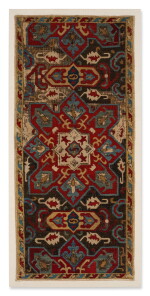
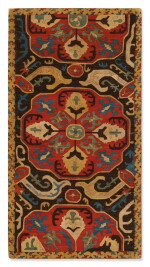
The design of the present rug can, however, be compared to Azerbaijan embroideries of the 17th and 18th centuries, where centralized medallion designs are more frequent, see the following two lots in the present sale, see also J. Wearden, ibid. pp. 102-111, figs. 1, 2, 3 and 7). The direction of the transference of designs used by both carpet weavers and embroiderers remains unclear but they share common roots in Safavid court weaving. The serrated dark blue central medallion, enclosing four palmettes, and issuing two above and below, echoes the cloud-collar medallions of court carpets, (see, for example, the Rothschild Tabriz Medallion Carpet in the Museum of Islamic Art, Doha), though here undoubtedly simplified but greatly expressive.
Features of later Caucasian rugs also find expressions in the present lot which has been variously attributed to Shirvan by Schurmann and Herrmann (U. Schurmann, Caucasian Rugs, 1961, pl. 63, and E. Herrmann, Asiatische Teppich- und Textilkunst (ATT), Vol. I, 1989, no. 22) as well as ‘Proto-Alpan’ Karabagh, when offered as part of Kirchheim’s Orient Stars collection (see Rippon Boswell, 2 October 199, lot 84).