
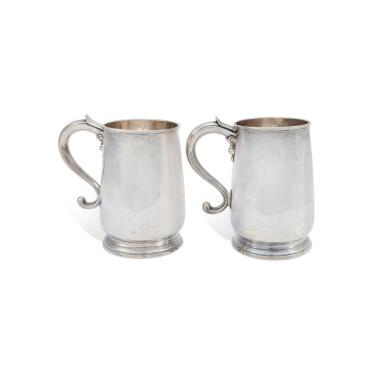
Property from the Collection of Roy J. Zuckerberg
A Pair of American Silver Canns of Medical Interest, Knight Leverett, Boston, Circa 1745
Estimate
12,000 - 18,000 USD
Lot Details
Description
tapered cylindrical with tuck-in bases, the capped scroll handle with applied baluster at upper handle terminal, the front engraved with coat-of-arms in baroque cartouche, marked on base and near rim to left of handle K.Leverett in rectangle (Kane mark A)
21 oz 5 dwt
659 g
height 5 ½ in.
14 cm
By descent in the Bulfinch family to Mrs. Charles H. Joy, 1911;
By descent to Benjamin Joy, 1949 Mark Bortman (1896-1967), collector, Boston, acquired in 1949;
William Core Duffy, July 13, 1992
Museum of Fine Arts, Boston, 1911, no. 703
RISD Museum, Providence, Rhode Island, 1965, no. 127
US Department of State, 1973-82 (on loan)
Florence V. Berger and George M. Curtis, American Church Silver of the Seventeenth and Eighteenth Centuries, 1911, no. 703, p. 84, pl. 24
Hugh J. Gourlay, The New England Silversmith: An exhibition of New England Silver from the Mid-Seventeenth Century to The Present, 1965, no. 127
Kathryn Buhler, American Silver, 1655-1825, in the Museum of Fine Arts, Boston, 1973, nos. 65a-b, pp. 6-7, 37
Patricia E. Kane, Colonial Massachusetts Silversmiths and Jewelers, 1998, p. 657
Jeanne Sloane, Artistry and Enterprise: American Silver 1660-1790 - Survey of American Colonial silver held in the collection of Roy J. Zuckerberg, New York, Smallwood & Stewart, 2018, no. 29, p. 68-69
The arms are those of Bulfinch, probably for Dr. Thomas Bulfinch Senior (d. 1757) or his son Dr. Thomas Bulfinch II (1728-1802), both of Boston. The father, who married Judith Coleman, was trained in medicine in England before coming to America. He was one of the first doctors to practice smallpox innoculation in America, doing the procedure as early as the 1730s, not long after its introduction in Europe.
His son continued his medical education in Europe after graduation Harvard, as Harvard Medical School was not established until the 1780s. Dr. Bulfinch II had clients such as John and Abigail Adams, and performed a successful mastectomy, a rare procedure for the time. Following in his father's footsteps, he particularly worked against smallpox, starting an inoculation hospital with Dr. Joseph Warren at Point Shirley in Boston Harbor. He married Susan Apthorp in 1759, daughter of one of the richest men in Boston, and their son was the famous Boston architect Charles Bulfinch.
Only sixteen pieces of silver survive by Knight Leverett. As Jeanne Sloane notes in her book, his small output may be explained by the fact that he sustained a general retail business alongside his silver business. Documents describe him alternatively as "shopkeeper" and "goldsmith" throughout his life (Kane 1998, pp.655-658).
You May Also Like


