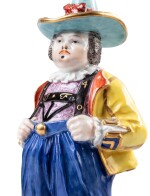

A rare Meissen porcelain figure of Court Jester Hofnarr Fröhlich, circa 1740
Live auction begins on:
June 24, 12:30 PM GMT
Estimate
8,000 - 12,000 EUR
Lot Details
Description
modelled by J. J. Kändler, his costume painted in the Saxon hunting livery colours of blue and yellow, his breeches gilded with the initials J.F for Johann Fröhlich and the date 1740, on top of a puce undershirt with scrafitto-scrolls, crossed swords mark in underglaze-blue
Height 10 in; 25,5 cm
Property from the collection of comte Anne-Jules de Noailles (1900-1979), Thierry de Maigret, Drouot, Paris, 5-6 December 2023, lot 55;
Acquired at the above sale.
Bibliographie comparative
R. Rückert, Der Hofnarr Joseph Fröhlich, 1694-1757, Taschenspieler und Spassmacher am Hofe Augusts des Starken, 1998.
Joseph Fröhlich (1694–1757), born in Austria, rose from comparatively modest beginnings to become one of the most celebrated and conspicuously documented figures at the court of Augustus II the Strong. Together with the so-called ‘Baron’ Schmiedel, he occupied a position within the ruler’s intimate entourage, achieving a degree of visibility and influence exceptional for a court entertainer. Fröhlich’s likeness circulated widely in the visual culture of Dresden: it appears in paintings by Bernardo Bellotto, in precious courtly jewellery, and, significantly, in porcelain produced at Meissen.
Fröhlich’s career commenced in 1725 at the court of the Margrave of Bayreuth, where he served as a juggler and jester. Through the intercession of the Margrave’s sister, Christiane Eberhardine of Brandenburg-Bayreuth, consort of Augustus the Strong, he was summoned to Dresden. There he assumed the role of Electoral and Royal Court jester, bearing a succession of characteristically playful titles: kurzweiliger Rat (entertaining counsellor), magician, and eventually, from 1744, Royal Polish Mühlenkommissar.
The earliest reference to a figure of Fröhlich is in the Porzellan-waren-Lager inventory of 7 March 1733, where it is listed under the designation: “Für den Königl. Printzen von Pohlen und Littauen und Chur-Fürstl. Durchl. zu Sachsen… 1. Josephs Figur.”, [for the Royal Prince of Poland and Electoral Serene Highness of Saxony ... 1 figure of Joseph]. Subsequently, in September 1736, the figure is recorded in Johann Joachim Kändler’s Arbeitsbericht: “Eine Josephs Figur in Thon geändert und verbeßert, damit solche aufs Neue hat können abgeformet werden”, [a figure of Joseph reworked and improved in clay so that it might be newly moulded].
The model appears to be derived from the engraved portrait “Joseph Frölig Hof=Taschen spieler” of 1729 by Christian Friedrich Boetius, with examples inscribed with dates spanning from 1733 to 1758—the latter marking the year following his death. A further example dated 1740 and with similar colouring was in the Robert G. and Ilse Vater Collection, sold at Christie’s, London, 16 December 2021, lot 113.
The model is most recently discussed by Vanessa Sigalas and Meredith Chilton, All Walks of Life, A journey with the Alan Shimmerman Collection, Meissen Porcelain Figures of the Eighteenth Century, Toronto, 2022, pp. 398-401; and by Sarah-Katharina Andres-Acevedo, Die autonomen figürlichen plastiken, Johann Joachim Kaendlers und seiner werkstatt zwischen 1731 und 1748, Stuttgart, 2023, Vol. 2, pp. 55-56.
Comte Anne-Jules de Noailles (1900-1979)
The only son of the Mathieu Fernand de Noailles (1873–1942) and Anna Bibesco-Bassaraba (1876-1933), princesse de Brancovan, the comte was raised in Parisian high society by a mother who held salons, bringing together the most famous intellectuals, writers and artists of the time. A great collector, Anne-Jules donated important pieces from his collection to the Louvre Museum, including fourteen pieces of 18th-century Meissen porcelain, and to the Musée national de la Céramique de Sèvres, he donated twenty pieces of 18th-century Vincennes and Sèvres porcelain.
Related Literature:
Rainier Rückert, Der Hofnarr Joseph Fröhlich, 1694-1757, Taschenspieler und Spassmacher am Hofe Augusts des Starken, 1998.


