
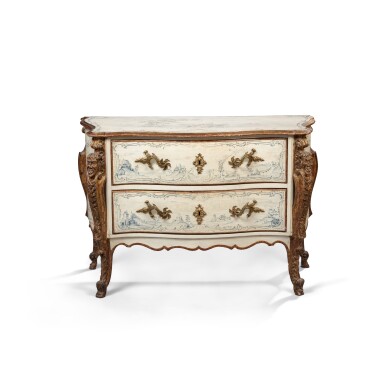
A German gilt-bronze mounted painted and giltwood commode, Munich, circa 1750, probably after a design by Joseph Effner or François de Cuvilliès
Live auction begins on:
June 24, 12:30 PM GMT
Estimate
10,000 - 15,000 EUR
Lot Details
Description
with two long drawers, decorated with landscapes and hunting scenes in blue camaïeu on a cream ground, the mounts adorned with satyr heads, standing on curved legs fitted with sabots
Haut. 86,5 cm, larg. 126 cm, prof. 56,5 cm ; Height 34 in, width 49 2/3 in, depth 22 ¼ in
This elegant German commode, with its projecting corners and low-relief decoration, displays the characteristic Rococo vocabulary developed by Bavarian architects and cabinetmakers in the 1740s, exemplified by the famous Reichen Zimmer, the state apartments of the Munich Residence, designed by the court architect François de Cuvilliés (1695–1768). A commode in the Residence, with similar relief decoration and more pronounced projecting corners, by Johann Adam Schmidt, is reproduced in H. Kreisel, Die Kunst des Deutschen Möbels, Munich, 1970, vol. II, fig. 447; another, of a more similar general form and previously traded on the Munich art market, is illustrated in the same book, fig. 439.
This commode, with its typically German construction, is inspired by the designs of François de Cuvilliès and his mentor, the architect Joseph Effner (1687-1745), himself trained in Paris by Germain Boffrand (1667-1754). Maximilian II, Elector of Bavaria and a great admirer of French art, sent many of his artists to Paris for training and established a French furniture workshop at his court in the early 18th century. This workshop employed eighty artisans and produced furniture in the French style, for which Joseph Effner provided designs inspired by the works of André-Charles Boulle and Charles Cressent. Cuvilliès' work at the Munich Residence and the Amalienburg Pavilion in the Nymphenburg Palace gardens reflects his talent for interpreting the French Rococo style in a more exuberant and dynamic manner. Indeed, while drawing inspiration from French models, he knew how to break free from them to create a much more exuberant style. Beginning in 1738, he published designs for woodwork, furniture, and objets d'art that circulated throughout Europe. The Livre des differents desseins de Commodes, published between 1742 and 1745, features models with two drawers separated by a visible rail and carved with scrolling foliage, flanked by prominent uprights.
A pair of German painted and giltwood commodes in the same style, made around 1740 after François de Cuvilliès, probably by Joachim Dietrich, with two drawers and two side doors, flanked by detached uprights adorned with espagnolettes, is in the J. Paul Getty Museum, illustrated in C. Bremer-David, Decorative Arts: An Illustrated Summary Catalogue of the Collections of the J. Paul Getty Museum, Malibu, California, p. 228, no. 396.
You May Also Like


