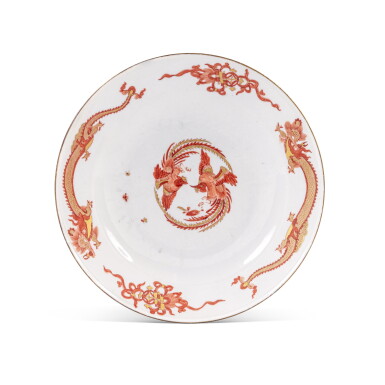
A Meissen porcelain 'Red Dragon' pattern plate, circa 1735-40
Estimate
1,000 - 1,500 EUR
We may charge or debit your saved payment method subject to the terms set out in our Conditions of Business for Buyers.
Read more.Lot Details
Description
painted in iron-red and enriched in gilding with two circling phoenixes in the centre, and with dragons and auspicious symbols at the gilt-edged rim, crossed swords mark in underglaze-blue
Diameter 21.3 cm; 9 ⅜ in
The Meissen 'Red Dragon' Service (Roter Drache) is one of the earliest and most important porcelain services produced by the Meissen factory and was created during the reign of Augustus the Strong, Elector of Saxony and King of Poland, who was an avid collector of Asian porcelain. See Julia Weber, Meißener Porzellane mit Dekoren nach ostasiatischen Vorbildern, Band 2, Munich, 2013, pp. 246-254, for a detailed account of the origins and history of the service, the decoration of which is based upon a Japanese original (Weber, op. cit., ill. 39). Production may have started as early as 1729, for the Paris merchant, Rudolph Lemaire, who planned to sell the copies of Asian porcelain that he ordered at Meissen in Paris as the more expensive originals. After the Lemaire plot was uncovered and the porcelain that he ordered was confiscated to the Japanese Palace, it seems that porcelain with this decoration was initially allowed to be sold to the public (Weber, p. 248). It is probable that Augustus the Strong only reserved the pattern for the sole use of the Court shortly before his death on 1st February 1733. At the beginning of November 1734 his successor, Augustus III, chose the 'Red Dragon' pattern to decorate the first Dresden court service of Meissen porcelain. The first delivery was made in 1735, with further deliveries following throughout the 18th and 19th centuries.