
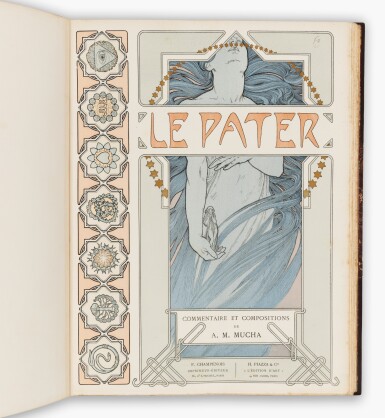
Mucha, Alphonse | Le Pater, 1899
Lot closes
June 25, 08:31 PM GMT
Estimate
8,000 - 12,000 USD
Starting Bid
5,500 USD
We may charge or debit your saved payment method subject to the terms set out in our Conditions of Business for Buyers.
Read more.Lot Details
Description
Mucha, Alphonse
Le Pater. Paris: F. Champenois and H. Piazza, 20th December 1899
Folio (397 x 306 mm). Printed rectos only, half title, dedication leaf, color lithographed title page, 8 plates, 7 leaves of text with ornamental borders, limitation leaf, colophon leaf, and with 7 black-and-white lithographed plates; intermittent pale spotting, with some expected light offsetting to the blank versos. Near contemporary three-quarters dark brown crushed morocco leather, gilt ruled, spine gilt lettered and decorated with a floral motif featuring red and green leather onlays, marbled paper boards, the binding signed by Paul Affolter (active 1880-1929), original printed wrapper bound in; Rubbing and a few small spots of wear to the extremities and rear board.
Limited edition, copy 247 of 510, of Alphonse Mucha’s sumptuously color-printed art nouveau artist’s book, his symbolist masterpiece.
According to the artist, this book the most important achievement of his career. He was not it’s only admirer—Charles Masson, the influential critic, reviewed Mucha’s book in Art et Decoration, as “an opus of remarkable unity of ideas and execution.”
Dissatisfied with an unending stream of commercial projects, from theatre posters to door handles, Mucha wanted a change. In 1898, he began to work on a book of entirely his own conception, a vehicle for his visionary beliefs that would showcase both his writing and his artistry — this illustrated edition of The Lord’s Prayer. This was an artwork made to serve a higher purpose, replete with Christian allegory and masonic symbolism, conveying both a philosophical and a spiritual message.
As Mucha recounted: “I became a victim of my own device. Besides—I had not found true satisfaction in [commercial] work of this kind. I saw my path as lying elsewhere, somewhat higher. I was looking round for a means to spread light that would reach into the remotest corners. I did not have to look long. The Lord’s prayer. Why not give its words pictorial expression?” He goes on to explain how he envisioned the book’s structure: “first the cover page with symbolic ornamentation, then the same ornaments, developed in a sort of variation around one line of the Prayer, the third page explaining in calligraphic writing the idea contained in that line, the fourth rendering this idea in a picture, and so on, line after line until the end” (Jiri Mucha, Alphone Maria Mucha… p. 138).
REFERENCES
Jiri Mucha, Alphonse Maria Mucha: His Life and Art. New York: Rizzoli, 1989).
PROVENANCE
Unidentified heraldic book label to the front pastedown


![[United Brethren] | The Congregation of God in the Spirit](https://sothebys-md.brightspotcdn.com/dims4/default/89b32e8/2147483647/strip/true/crop/1581x2000+0+0/resize/150x190!/quality/90/?url=http%3A%2F%2Fsothebys-brightspot.s3.amazonaws.com%2Fmedia-desk%2Fwebnative%2Fimages%2F45%2F52%2Fa689629e429aa53a810710ea1a02%2Fn12185-dgb8x-t2-02.jpg)


![[Richard Blackmore]. Letters between Theophilus and Eugenio, a 1747 Franklin Imprint](https://sothebys-md.brightspotcdn.com/dims4/default/57cd866/2147483647/strip/true/crop/1581x2000+0+0/resize/150x190!/quality/90/?url=http%3A%2F%2Fsothebys-brightspot.s3.amazonaws.com%2Fmedia-desk%2Fwebnative%2Fimages%2F45%2F9c%2F1c9420b74bfab91309c503280882%2Fn12185-dgbcv-t2-02.jpg)

