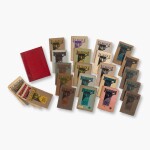

Forty Highlights from the Stock of Richard C. Ramer Old & Rare Books
A Águia | Organ of the Portuguese Renaissance, complete run of important Portuguese literary review
Lot closes
June 25, 06:01 PM GMT
Estimate
4,000 - 5,000 USD
Starting Bid
2,800 USD
We may charge or debit your saved payment method subject to the terms set out in our Conditions of Business for Buyers.
Read more.Lot Details
Description
A Águia
Porto: [Various printers and publishers], 1910–1932
205 issues in 5 series, first series: folio (305 x 233 mm), second–fifth series: 8vo (230 x 150 mm). Eagle illustration to title pages of first series and to covers of second series; dampstaining and foxing to title and preceding leaf of first series, minor repair to upper margins of n° 8 (first series), toning to leaves predominately in later series, lightly foxed throughout. First series with old quarter red sheep over pebbled boards, smooth spine gilt-lettered with fillets, decorated endpapers, second–fifth series in original printed and illustrated wrappers; boards of first series slightly rubbed, second–fifth series with worn spines and chipping to wrappers.
First editions of a complete run of the most noteworthy Portuguese literary review.
This incredibly important review marked a dynamic collaboration between Portuguese modernist writers, ultimately becoming their platform to reimagine Portugal's past and interpret its future. A Águia (The Eagle) ran from 1910 to 1932. Its first series released just four months after the abdication of the Portuguese king, it continued through the First Portuguese Republic, and it concluded with its final series published in the closing months of military dictatorship.
Under the expert direction of Álvaro Pinto, Teixeira de Pascoaes, António Carneiro, José Magalhães, Leonardo Coimbra, and Sant’ Anna Dionísio, A Águia was the brainchild and perhaps the mouthpiece of growing nationalist sentiment in the early Republic. Looking to ground the new government and renew the soul of the nation under works of culture, the review boasts many previously unpublished works and letters of António Nobre, Alexandre Herculano, Almeida Garrett, Antero de Quental, António Feliciano de Castilho, and others. The second series, comprising 120 issues, features Fernando Pessoa's first Portuguese work of prose to appear in print. In "A nova poesia portugueza socialogicamente considerada," Pessoa defended the creation of a "supra-Portugal" with the coming of another literary titan like Luis de Camões.
The review's subtitle would change numerous times over its run—3 times within the first series alone. Early issues appeared as Revisita ilustrada de literature e critica (Illustrated magazine of literature and criticism), then simplified to the basic Revista quinzenal (fortnightly magazine) before it became Revista quinzenal illustrada de literatura e crítica. Progressing with its editorial team, the second series was subtitled Revista mensal de literatura, arte, ciência, filosofia e crítica social (Monthly magazine of literature, art, science, philosophy and social criticism) with the new addition of "Orgão da Renascença Portuguesa (Organ of the Portuguese Renaissance)" to its front covers.
Almost all sets of A Águia have numbers "10/11" of the fourth series in facsimile, if at all. The present set has these numbers in the extremely rare original.
When it was brought to light by Dionísio that Gustavo Cordeiro Ramos, minister in the dictatorship, had plagiarized a study about Goethe from number 10/11 of the fourth series, the issue was suppressed. As a result, almost no sets of A Águia contain number 10/11 of the fourth series appear in its original edition.
Sold as a group, not subject to return.
REFERENCES
Daniel Pires, Dicionário da imprensa periódica literária portuguesa do século XX (1900-1940), pp. 40-9; Dicionário das revistas literárias portuguesas do século XX, pp. 55-8; Clara Rocha, Revistas literárias do século XX em Portugal, pp. 268-86, 637-8




![[Jane Austen] | Mansfield Park, 1814, first edition, 3 volumes, the Methven Castle copy](https://sothebys-md.brightspotcdn.com/dims4/default/36c777e/2147483647/strip/true/crop/2000x2000+0+0/resize/150x150!/quality/90/?url=http%3A%2F%2Fsothebys-brightspot.s3.amazonaws.com%2Fmedia-desk%2Fwebnative%2Fimages%2Ffd%2F66%2F0d8bf2b9425694336324969286e7%2Fl26403-djllh-t1-01.jpg)

![Fernandez [de Palencia], Diego | First edition of an early history of Peru, signed by the author](https://sothebys-md.brightspotcdn.com/dims4/default/90fff90/2147483647/strip/true/crop/1602x2000+0+0/resize/150x187!/quality/90/?url=http%3A%2F%2Fsothebys-brightspot.s3.amazonaws.com%2Fmedia-desk%2Fwebnative%2Fimages%2Fb7%2F35%2F7eae757d4dad810ca75855199acd%2Fn12191-dlys7-t2-02.jpg)

