
Property from the Collection of David H. Murdock
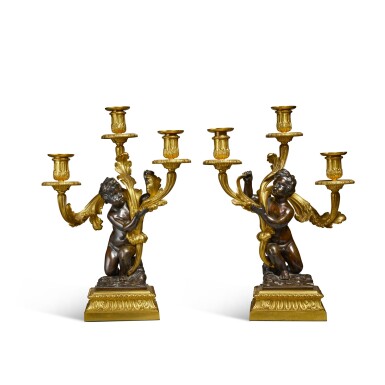
A Pair of French Gilt and Patinated Bronze Three-Light Candelabra, First Half 19th Century
No reserve
Lot closes
April 14, 05:05 PM GMT
Estimate
8,000 - 12,000 USD
Current Bid
700 USD
9 Bids
No reserve
We may charge or debit your saved payment method subject to the terms set out in our Conditions of Business for Buyers.
Read more.Lot Details
Description
in the form of seated putti with raised arms and three acanthus scroll candle branches terminating in fluted and leaf carved nozzles, on square concave fluted bases; nozzles and drip pans drilled for wiring
height 18 in.; width 12 3/4 in.
45.5 cm; 32.5 cm
Charles, 1st Lord Hillingdon (1830-1898);
Mr and Mrs Robert Tritton, Godmersham Park, Kent;
Christie's on the Premises, Godmersham Park, Kent, 6-9 June 1983, lot 17.
Michael M. Thomas, 'Bellagio House. The David Murdock Estate in Bel-Air', Architectural Digest, February 1987, p.52 (one candelabrum illustrated)
Although the design of this popular model is traditionally attributed to the sculptor and bronzier Philippe Caffieri, the putti figures are in fact taken from 17th-century Roman Baroque models of infant musicians thought to emanate from the circle of Alessandro Algardi (1595–1654) or François Duquesnoy (1597–1643). A set of four 18th-century French casts of these models on gilt bronze bases, depicting an infant boy holding a shell, another blowing into a double conch shell, and two others playing the flute and the triangle, is in the Wallace Collection, London (S202-5; R. Wenley, French Bronzes in the Wallace Collection, London 2002, p.84). The production of this group was probably orchestrated by one of the Parisian marchands merciers, who would have also adapted the models for use as candelabra, with the arms and bases possibly designed by Caffieri (1714-1774), son of the sculpteur, fondeur et ciseleur du roi Jacques Caffieri who took over his father's workshop after his death in 1755.
Numerous surviving pairs are recorded on the market, including one sold Christie's London 6 December 2006, Lot 250, and another formerly in the Baron de Rothschild and Ojjeh-Wildenstein Collections, sold Sotheby's Monaco, 25-26 June 1979, lot 51.
You May Also Like


