
Property from the Collection of David H. Murdock
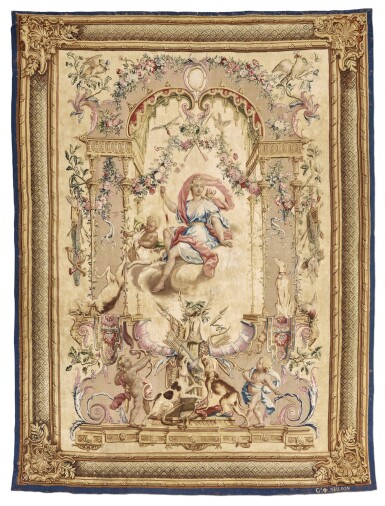
A Gobelins Tapestry representing Diana, from Portières des Dieux Series, woven by the Workshop of Jacques Neilson (1714-1788), third quarter 18th century
Lot closes
April 14, 04:16 PM GMT
Estimate
18,000 - 22,000 USD
Starting Bid
11,000 USD
We may charge or debit your saved payment method subject to the terms set out in our Conditions of Business for Buyers.
Read more.Lot Details
Description
depicting Diana as a personification of Earth
signed G. s. ⚜. NEILSON on the lower right corner of panel
silk and wool
11 ft. 8 in. by 8 ft. 7 ½ in.; 355.6 by 262.9 cm
This tapestry is part of the Portières des Dieux series, which personifies the Four Elements and the Four Seasons through the depiction of Roman gods and goddesses. The series was originally designed by Claude Audran III (1658–1734) for the French royal tapestry manufactory, Gobelins, and proved so popular that it was continually re-woven between 1700 and 1789. Minor variations were introduced through the years, such as changes in background color and patterns and the addition of gold and silver thread.
The present composition, depicting Diana with her head turned to the right, a fallen doe at her left and a greyhound at her right, represents a later iteration of the subject. It was introduced around 1758 after the original model — its mirror image — was retired due to overuse of the cartoon used to produce the weaving.1
The weaver of this panel, Jacques Neilson, served as the head of the basse lisse at the Gobelins Royal manufactory, where he executed the Portières des Dieux series until 1788. He is recorded as having produced versions of Diana, as the personification of Earth, as early as 1749.2 He is also known to have woven pieces from the Portières des Dieux series for notable patrons including the French Royal Crown, the Duke of Richmond (1762), and the Infante Philip, Duke of Calabria, among others.3
Three different borders were designated for this series; the example seen here represents the third version, designed by Pierre-Josse Perrot and introduced in 1740.4
1M.M. Fenaille, Tapisseries des Gobelins, Volume III, Paris, 1904, p. 8.
2Ibid., pp. 1 - 60.
3Ibid., pp. 1 - 60.
4Ibid., p. 11.
You May Also Like


