
Property from the Collection of David H. Murdock
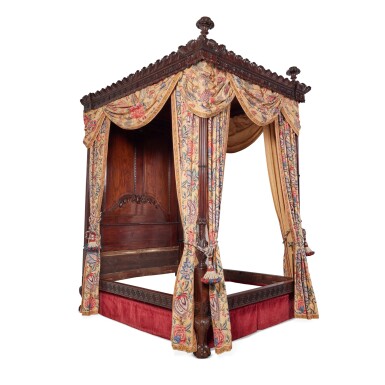
A George II Carved Mahogany Tester Bed, Mid-18th Century
Lot closes
April 14, 03:31 PM GMT
Estimate
12,000 - 18,000 USD
Starting Bid
7,500 USD
We may charge or debit your saved payment method subject to the terms set out in our Conditions of Business for Buyers.
Read more.Lot Details
Description
the tester with urn finials above a gadrooned cornice with fluted and rosette frieze; the panelled back and top with applied carved acanthus and cabochons; the front cluster-column posts with bulbous acanthus carved bases above Greek-key fretwork rails on cabriole legs with claw-and-ball feet
height 112 in.; length 86 in.; width 69 in.
285 cm; 218.5 cm; 175 cm
Charlton House, Greenwich, London;
The Jerome C. Neuhoff Collection, Sotheby's New York, 25 January 1986, lot 182.
Percy Macquoid and Ralph Edwards, The Dictionary of English Furniture, London 1927, Vol.I p.38 fig. 27
Alice Winchester, 'An American Collection of English Antiques', The Connoisseur Yearbook, 1954, p.52 no. XIV
Alice Winchester, ed., 'England's age of mahogany', Living With Antiques, New York 1963, p.284
Charlton House is a Jacobean mansion constructed between 1607-1612 for Sir Adam Newton, Dean of Durham and tutor to Prince Henry, eldest son of James I, in the village of Charlton between Blackheath and Woolwich and now part of the Royal Borough of Greenwich, Greater London. The house passed through several owners in the ensuing centuries, including the East India Company merchant Sir William Langhorne (d.1715) in 1680 and then his nephew John Conyers (1649-1719), and thence by inheritance to the Maryon-Wilson baronets by the nineteenth century. The 11th Baronet, Sir Spencer Pocklington Maryon-Wilson (1859–1944), sold the estate to Greenwich Council in 1925, who now operate the house and grounds as an events centre and visitor attraction.
Jerome and Elizabeth Neuhoff formed a collection of late 17th and 18th century English furniture between the 1930s and 1950s for their Georgian-style house at King's Point on the north shore of Long Island, with a particular focus on richly carved mahogany furniture of the late George II and early George III eras. The collection was sold in an important single-owner auction in New York in 1986.
You May Also Like


