
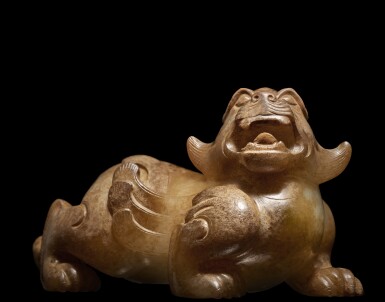
An exceptionally rare and superb white and russet jade mythical beast, Han dynasty | 漢 玉神獸
Premium Lot
Estimate
Upon Request
Premium Lot
Lot Details
Description
8.9 cm
Its eyes bright with power, its jaws fearsome yet benevolent, its stance solid yet full of movement; the present figure represents one the finest and most important examples of Han dynasty (206 BCE – 220 CE) jade carving ever to come to market. Employing the full range of lapidary techniques known to the Han carver, the beast – hewn from the finest creamy russet stone – is a marvel of early figural work.
This enigmatic figure is a bixie. Also known as a pixiu or other auspicious monikers, horned lion-like creatures, usually with wings, were among the most striking visual innovations of the Han dynasty. While the origins of the form are hotly debated, the grandeur of its wings, the power of its legs and the majesty of its feline face all bear close resemblance to winged lion forms in vogue across Western Asia from the earliest antiquity. Indeed, it could be said that the Han dynasty represents the first moments in Chinese history where scholars turned to the world beyond China for inspiration, mystery and beauty. From the Classic of Mountains and Seas (Shanhaijing) to the codification of the Book of Odes (Shijing) and the Records of the Grand Historian (Shiji), Han literature – the basis of the Chinese classical canon to this day – is replete with references to the world beyond; the mysteries and fantasies of distant lands. While the Shiji refers to pixiu as a native wild beast tamed by the Yellow Emperor himself (see Annals of the Five Emperors), the Book of Han (Han shu, 111 CE) describes the beasts as native to Wuyishanli in the Western Regions, today identified with Alexandria Prophthasia near modern-day Iran.
Bixie, whose name literally translates to ‘ward off evil,’ soon were adopted and adapted into the visual canon of the Han dynasty, where their enduring protective imagery and majesty led to their close association with funerary arts and the royal court. Monumental stone sculptures of animals and their small jade counterparts were found at Han dynasty burial sites, and are believed to have served the function of protecting their owner and leading the way to paradise. And, while extant jade examples are now exceedingly rare, a number of important stone counterparts remain extant, guarding the ‘spirit roads’ to important Han tombs. Compare, for example, the iconic Eastern Han stone bixie now preserved in the Luoyang Museum, the largest of its kind preserved in China, unearthed from Youfang village, Luoyang, Henan province, in 1992 (fig. 1).
While jade carving in the round can trace its origins to the Shang (ca. 16th–11th century BCE) and Zhou (ca. 1046–771 BCE) dynasties, the sensitivity, realism and intimacy of Han depictions represents a significant departure from earlier prototypes – incorporating a broad range of relief-work and detailing that bring carved figures to life. As Ming scholar Gao Lian (fl. ca. 1600) notes,, ‘Han dynasty carving is exquisite in its double-line engraving; the grinding technique flows smoothly and delicately, as fine as an autumn hair, with no gaps or breaks in the lines, resembling a flowing drawing without any hesitation.’ (see Wang Zhangqi, ed., Zhonghua guobao: Shanxi zhengui wenwu jicheng. Yuqi juan [National treasure: Collection of rare cultural relics of Shaanxi Province. Jade volume], p. 222).
Surviving comparable examples of jade bixie are extraordinarily rare. The most famous example, more upright in stance than the present, was preserved in the Qing Court Collection and now in the Palace Museum, Taipei (accession no. gu yu-2789), and is illustrated in Five Thousand Years of Chinese Art Series: Chinese Jades of the Han Dynasty, Taipei, 1990, pl. 79, alongside other closely comparable examples, including a jade bixie with a tubular fitting excavated from a tomb in Baoji, Shaanxi, pl. 80; and a bixie in the National Museum of Asian Art, Washington, pl. 78.
Another bixie, slightly more upright than the present but with very closely related expression carving style and stone colour, was excavated from the Weiling Mausoleum in Xinzhang village at Zhouling town, Xianyang city, Shaanxi province in 1972 and is now preserved in the Xianyang Museum, illustrated in Gu Fang, The Complete Collection of Unearthed Jades in China, vol. 14: Shaanxi, Beijing, 2005, pl. 163; another from the collection of Sir Joseph Hotung, acquired in our New York rooms, 2nd November 1979, lot 51, is now preserved in the British Museum, London (accession no. 2022,3034.256), and illustrated in Jessica Rawson, Chinese Jade from the Neolithic to the Qing, London, 1995, pl. 26:7, where the author describes its finely incised lines imitating fur and deeply carved sculptural curves as ‘typical of the early animal-shaped jades of the Han dynasty.’
For another very closely related carving with a frontal snarling face, whiskers and two horns, compare the famous winged waterpot excavated in 1984 from the Han tomb at Laohudun, Ganquan, Yangzhou, Jiangsu, illustrated in Zhongguo yuqi quanji [The complete collection of Chinese jade], vol. 4, Shijiazhuang, 1993, pls 251 and 252; and a related figure from the Qing Court Collection, usually attributed to the Wei or Jin period, illustrated in The Complete Collection of Treasures of the Palace Museum, vol. 40: Jadeware (I), Hong Kong, 1995, pl. 229.
玉神獸目光炯炯,張牙示人威姿生猛,猶隱見仁善可愛,四足有力穩扎后土,仍周身動態躍躍,可謂市場歷年來,罕得最為精緻、珍稀的漢代玉雕。玉匠人窮盡琢石巧技,取材至臻寶玉,光柔質潤,造就如此精采高古玉作,在漫漫歷史長河中輝耀動人。
神獸「辟邪」,又稱「貔貅」,身形類獅、額上帶角、多得羽翼,乃漢代藝術造形上最創新亮眼之例。其原型起源雖未定,細觀之,其羽翅豐麗、足腿強健、面容似豹若虎,無疑王者非俗,與泛西亞自古流傳之翼獅,有異曲同工之趣。漢朝或可謂中國史上首見學者往國境之外,追尋知識、文化、神話,從《山海經》到《詩經》與《史記》,奠基中國哲學與文學的經典重書,皆滿載對於未知世界的想像與構築。《詩經》提到黃帝曾馴服貔貅,《漢書》述貔貅源自西域的烏弋山離國,即是今時伊朗附近之古國,亞歷山大里亞·普洛夫達西亞。
神獸「辟邪」,意謂「趨避邪惡」,其圖像迅速即盛行於漢朝,象徵保衛守護,且形象威嚴尊貴,與朝廷皇室、喪葬儀典關係密切。漢陵周圍可見大型辟邪雕塑,小型玉雕亦見於墓葬中,廣信作為守護墓主,助其往生淨土之用。現存玉雕雖罕,大型石雕可見守於漢陵神道遺址。比較洛陽博物館藏東漢石雕辟邪像,聞名世界,屬同類中最大尺寸,1992年出土於河南孟津縣(圖1)。
圓雕玉器可溯至商、周,然而漢代圓雕之寫實細膩,獨樹一格,顯與前朝傳統相異,漢例更為立體精緻,栩栩如生。明代學者高濂論漢玉,「漢人琢磨,妙在雙鈎,碾法婉轉流動,細入秋毫,更無疏密不勻,交接斷續。儼如遊絲白描,毫無滯跡」。見王長啓編,《陝西珍貴文物集成:中華國寶:玉器卷》,頁222。
存世的漢玉辟邪極罕,最知名者如台北故宮博物院藏例(藏品編號:故玉2789),獸首姿態較本品更高仰,清宮舊藏,刊於《中華五千年文物集刊:玉器篇(漢代)》,台北,1990年,圖版79,同錄其他類例,包括陝西寶雞墓葬出土,帶管辟邪,圖版80,及華盛頓國立亞洲藝術博物館藏玉辟邪,圖版78。
1972年陝西省咸陽市周陵鎮新庄村,漢元帝渭陵遺址出土一件玉辟邪,神獸表情、風格、石質皆與本品近似,面首姿態更為上挺,現藏襄陽博物館,錄於古方,《中國出土玉器全集:陝西》,卷14,北京,2005年,圖版163;另一例為何鴻卿爵士珍藏,購於紐約蘇富比,1979年11月2日,編號51,現存於倫敦大英博物館(藏品編號:2022,3034.256),載於Jessica Rawson,《Chinese Jade from the Neolithic to the Qing》,倫敦,1995年,圖版26:7,作者記述此品以極細刻線描寫毛羽,至於玉雕造形之立體轉折,則大膽運用深刻技法呈現對比,可見「漢代早期動物造形玉雕之典型風格」。
參考1984年江蘇揚州邗江老虎墩東漢墓出土,辟邪形玉壺,獸面齜牙咧嘴,長鬚雙角皆與本品近類,出版於《中國玉器全集》,卷4,石家莊,1993年,圖版251、252。另見清宮舊藏一例,多斷為魏、晉時期,錄於《故宮博物院藏文物珍品全集:玉器(上)》,卷40,香港,1995年,圖版229。
--------------------
fig. 1
A stone winged chimera, Eastern Han dynasty, found in Mengjin, Henan, in 1992; Luoyang Museum, Henan.
圖1
東漢 石雕辟邪 1992年河南孟津縣出土 河南洛陽博物館