
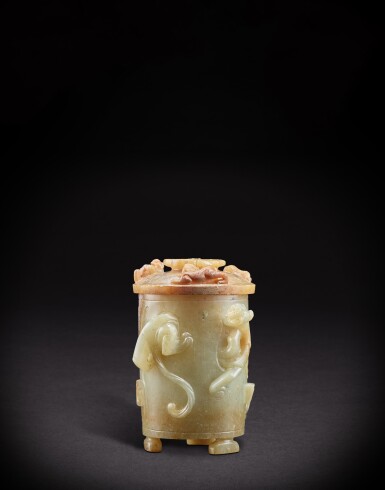
A very rare white and celadon jade 'dragon and phoenix' cup and cover, zhi, Han dynasty | 漢 浮雕螭鳳紋帶蓋玉卮
Estimate
2,000,000 - 4,000,000 HKD
Lot Details
Description
10.2 cm
Splendor Jade Collection of the Han Dynasty, Taipei, 2025, no. 58.
Known as the zhi, this form was widely used for food and drink from the Zhou through the Qin, Han, and Jin periods. Characterised by its cylindrical body with straight sides and a deep interior, it typically bears a ring handle or semi-ring handle; some examples are fitted with covers, while others are not. Bronze and lacquer zhi are relatively common in the Han dynasty, whereas examples fashioned from jade are exceedingly rare.
Early textual sources, including the Hanshu [Book of Han] and Shiji [Records of the Grand Historian], record the use of the zhi as a drinking vessel. Unlike ordinary wine containers, however, it was strictly reserved for formal rituals and grand banquets. During the Han dynasty, the proliferation of such jade vessels was closely tied to prevailing alchemical practices and the elite's fervent pursuit of longevity. It was firmly believed that consuming food and drink from jade receptacles facilitated the absorption of the stone's 'vital essence' or jingqi, thereby aiding the user in the attainment of physical immortality.
See a smaller (7.8 cm) Western Han dynasty example, preserved in the Palace Museum, Tapei, (accession no. guyu 005659). The Taipei Palace Museum cup is similarly skilfully worked on the exterior in varying levels of relief around the exterior with mythical beasts and phoenixes, though lacking the three feet on which the present example stands, as well as its cover.
Compare another slightly larger (12.3 cm) Western Han white jade handled tripod zhi and cover preserved in the Beijing Palace Museum, (accession no. gu 00104004). The Beijing Palace Museum vessel is, however, decorated on the exterior in low relief with chilong rendered in scrollwork, in contrast to the high-relief treatment seen on the present piece and on the example in the Palace Museum, Taipei.
出版
《漢家琳琅》,台北,2025年,編號58
此類器形名曰「卮」,自周代至晉代廣泛用於飲食。其特徵為圓筒狀器身,直壁深腹,通常帶有環形或半環形鋬(把手),有蓋或無蓋皆有。漢代之銅卮與漆卮相對常見,然以玉精雕而成者則極為罕見。
據《漢書》及《史記》等早期文獻記載,卮亦作飲器。然與尋常酒器不同,其專用於隆重祭典或盛大宴席。漢代玉質器皿之興盛,與當時社會上層風行的服食方術及對長生不老的熱切追求息息相關。時人深信,使用玉質器皿飲食有利於吸收玉之「精氣」,從而助人達致長生久視乃至肉身不朽之神仙境界。
本品之出眾處,在於其外壁以高浮雕技法生動刻畫螭龍與鳳鳥,利用多視點組合與曲線扭轉,營造出極具張力的立體空間感。比較一例,見台北故宮博物院蓄一尺寸較小(7.8 公分)之西漢玉盃(館藏編號:故玉5659)。台北故宮之例,外壁同樣以錯落有致之浮雕技法精雕神獸與鳳鳥紋飾,然無蓋,亦無本品底部之三足。
另比一例,尺寸稍大(12.3 公分),為北京故宮博物院藏之西漢白玉三足蓋卮(館藏編號:故00104004)。然北京故宮之例,外壁乃以淺浮雕技法飾以卷曲狀螭龍紋,與本品及台北故宮例所施之豪放高浮雕處理截然不同。
You May Also Like


