
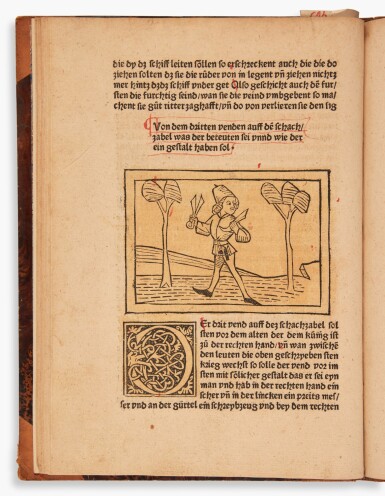
From the chess collection of Lothar Schmid
Jacobus de Cessolis | Schachzabelbuch, Strasbourg, 1483, von der Lasa copy
Estimate
50,000 - 70,000 GBP
We may charge or debit your saved payment method subject to the terms set out in our Conditions of Business for Buyers.
Read more.Lot Details
Description
Jacobus von Cessolis
De ludo scachorum... Schachzabel... das Buch menschlicher sitten vnnd der Ampt der Edlen. Strassburg: Heinrich Knoblochtzer, 1 September 1483
Fourth German edition (and second Strassburg edition), folio (268 x 192 mm). Collation: a-d8,6 e-f6: 40 leaves, gothic type, 44 lines, woodcut illustrations, extensive annotations to the first leaf, final text leaf, and terminal blank in an early modern hand, rubrication, nineteenth-century half marbled calf over marbled boards, spine gilt with red morocco label, marbled endpapers, occasional marginal dampstaining and soiling, e6 and f5-6 with paper repairs at margins (not affecting text or woodcuts), extremities lightly rubbed
AN EXCEPTIONALLY RARE GERMAN INCUNABLE EDITION OF THE FIRST PRINTED WORK ON CHESS: ONLY ONE OTHER COPY OF THIS EDITION (THE BLASS COPY) HAS BEEN RECORDED AT AUCTION IN OVER A CENTURY. A WIDE-MARGINED COPY WITH RUBRICATION.
Despite its rarity on the market, Jacobus de Cessolis' treatise was overwhelmingly popular in its day: fifteen other incunable editions of the work were printed, in Latin, Dutch, Italian, and English.
Cessolis was a thirteenth-century Dominican monk who wrote his treatise on "The Game of Chess" not as instruction on the rules and strategy of the game itself, but as a didactic allegory of the human condition. He does, however, describe the moves allowed each piece and the pawns, and his work is recognised as the first printed book on the greatest and most universal of all board games. Cessolis interprets the pieces of a single side as representing the stations of society: the five major pieces embody their actual roles — king, queen, knight, judge (the modern bishop), and king's deputy (the modern rook) — while the eight pawns are represented as a woodsman, a blacksmith, a wool merchant, a moneychanger, a doctor, an innkeeper, a watchman, and a water-carrier.
For other early editions of this work, see lots 11–15.
PROVENANCE:
Baron von der Lasa (1818–1899), legendary German chess master and chess historian, bookplate, with manuscript inventory number (No. 487), and inkstamp to title
LITERATURE:
USTC 743952 (listing 10 institutional copies); ISTC ic00418000 (listing 12 copies, of which at least 3 are imperfect); Gesamtkatalog der Wiegendrucke GW06530; van der Linde appendix II, pp. 130-131; Schmid p. 37; Goff C-418
You May Also Like
![Jacobus de Cessolis | De ludo scachorum, Toulouse, [c.1494], the Syston Park-von der Lasa copy](https://dam.sothebys.com/dam/image/lot/93529276-069a-4535-a1c4-67c3ccc359d2/primary/extra_small)
![Castiglione | Il libro del cortegiano. [Venice], April 1528, first edition, in a magnificent binding by Jean Picard for Jean Grolier](https://dam.sothebys.com/dam/image/lot/b5c5bb44-26ff-4321-8391-44a14b74e9dc/primary/extra_small)

![Jacobus de Cessolis | Libro di Givocho di Scacchi, [Florence,] 1493, the Dyson Perrins copy](https://dam.sothebys.com/dam/image/lot/fd1f7a9f-0f1a-44ee-ba39-1677cfb74589/primary/extra_small)


![Pedro Damiano da Odemira | Libro da imparare giocare a scachi, [?Rome, after 1524], fifth edition, Niemeijer copy](https://dam.sothebys.com/dam/image/lot/fb6f665d-0b6c-4695-9a07-0727da2684ce/primary/extra_small)


