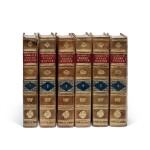

Edward Gibbon | The History of the Decline and Fall of the Roman Empire, 1776-88
Live auction begins on:
June 24, 02:00 PM GMT
Estimate
4,000 - 6,000 USD
Lot Details
Description
Gibbon, Edward
The History of the Decline and Fall of the Roman Empire. London: Printed for W. Strahan and T. Cadell, 1776-1788
Large 4to (276 x 219 mm). Six volumes, half titles, with engraved portrait of Edward Gibbon after Joshua Reynolds in vol. 1, two folding maps in vol. 2, a folding map in vol. 3, the maps by Thomas Kitchen, with an 1819 leaf of manuscript quotations from the text laid into vol. 2; infrequent light foxing, some marginal toning to the first and last few leaves, light offsetting in maps, a few minor blemishes like small holes, ink smudging, soiling, staining, or creases, a marginal tear in page 645 of the sixth volume, a tiny marginal hole and two short marginal tears in the maps. Full tan calf, boards with blindstamped borders, spines in six compartments, red and blue leather gilt lettered spine labels; rebacked, the leather dry and worn, light cracking and some scuffs to the boards, the hinges generally cracked or starting, the upper board of the sixth volume detached, the spines lifting at heads of three volumes, the top spine compartment on vol. 3 nearly detached.
First edition of Edward Gibbon’s seminal history of the Roman Empire.
Gibbon's "masterpiece of historical penetration and literary style" (PMM). The book sold with great rapidity and the first edition of volume 1 was, according to the author, exhausted within a few days. According to David Womersley (writing in the Oxford DNB) Gibbon does not seem to have exaggerated when at the end of his life he recalled that "my book was on every table, and almost on every toilette."
"It is often assumed that the Decline and Fall is a straightforward lament for departed glory, and that the dominant emotional coloring of the work is that of an elegy. But Gibbon was the enemy of empire as a political form, and a friend to the freedom of nations, for 'there is nothing perhaps more adverse to nature and reason than to hold in obedience remote countries and foreign nations, in opposition to their inclination and interest' (Decline and Fall, 3.142). However much Gibbon may have admired the artistic and cultural achievement of Rome, he was no admirer of empire as a political system. This disenchantment with empire influenced Gibbon's assessment of the barbarians who overran the western provinces of the empire in the fifth century. Gibbon's admiration for the barbarians had its limits..." (David Womersley, Oxford DNB)
REFERENCES
Printing and the Mind of Man, 222