
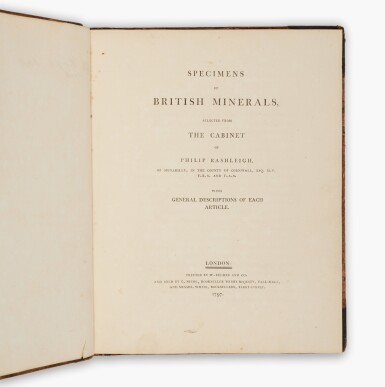
Rashleigh, Philip | Specimens of British Minerals, presentation copy
Lot closes
December 12, 09:35 PM GMT
Estimate
4,000 - 6,000 USD
Current Bid
3,200 USD
1 Bid
Reserve met
We may charge or debit your saved payment method subject to the terms set out in our Conditions of Business for Buyers.
Read more.Lot Details
Description
Rashleigh, Philip
Specimens of British Minerals. London: W. Bulmer and Co., 1797
Part 1 only, 4to (278 x 214 mm). 33 engraved plates, mostly aquatint and hand-colored; minor oxidization of hand-coloring. Half calf over marbled boards; joints starting, edges rubbed, covers somewhat soiled.
Presentation copy, given to Edward Fox by the author.
One of the most beautiful early works on mineralogy, Specimens of British Minerals was issued in two parts (1797–1802) to illustrate Philip Rashleigh’s celebrated collection of Cornish minerals and fossils, begun around 1765. The plates—engraved by the Cornish artist Henry Bone and later by Thomas Medland, with coloring by Thomas Richard Underwood—depict many of the finest specimens then known, including classic examples of chalcopyrite, liroconite, and pharmacosiderite. Written at the urging of visitors and correspondents who sought a record of his holdings, Rashleigh’s work remains an important work on eighteenth-century mineral collecting.
This copy was presented by the author to Edward Fox of Gonvena House, Wadebridge, a Cornish Quaker merchant and mining adventurer. Fox was a partner of Rashleigh’s cousin, Charles Rashleigh, in the Polgooth, Cockshead, and Mulvra mines near St Austell, among the most productive and technologically advanced operations in late eighteenth-century Cornwall. Their ventures, which employed the Boulton and Watt engine and produced vast profits at the century’s turn, underwrote Charles Rashleigh’s development of Charlestown harbour for the export of tin.
See also following lot.
REFERENCES
Schuh 4032; Ward & Carozzi 1833
PROVENANCE
Edward Fox, Gonvena House, April 20 1797 (presentation inscription on slip to pastedown)
You May Also Like


![William Langham | The Garden of Health, 1579 [i.e. 1597], first edition of an early guide to herbal remedies](https://dam.sothebys.com/dam/image/lot/9fba010c-0704-4974-aefc-0d1f24418d19/primary/extra_small)


![[Chronicles of England], Wynken de Worde, 1497](https://dam.sothebys.com/dam/image/lot/a0047393-820a-4028-917c-5f31290a3f9f/primary/extra_small)


