
Collection of Baron and Baronne Bertrand de Giey
Attributed to David Ryckaert II
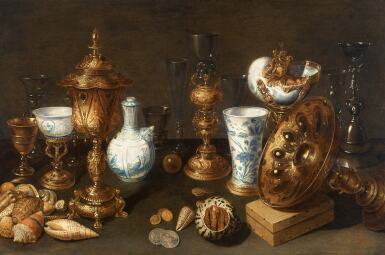
Still life with shells, nautilus cup, vases, glasses and coins
Auction is live
Lot closed
Estimate
25,000 - 35,000 GBP
Lot Sold
40,640 GBP
Lot Details
Description
Collection of Baron and Baronne Bertrand de Giey
Attributed to David Ryckaert II
Antwerp 1586–1642
Still life with shells, nautilus cup, vases, glasses and coins
oil on single-plank oak panel
unframed: 60 x 90.8 cm.; 23⅝ x 35¾ in.
framed: 81 x 111.2 cm.; 31⅞ x 43¾ in.
With Rafael Valls Gallery, London, by 1999;
From whom acquired by Jacques Hollander (1940–2004) and Galila Hollander;
Their sale (‘Le cabinet de curiosités de Jacques et Galila Hollander’), Paris, Christie’s, 16 October 2013, lot 83 (as David Ryckaert the Younger), for 85,500 euros;
Where acquired by the Baron and Baronne de Giey;
Thence by descent.
Brussels, l'Espace culturel ING, Magie de l'Orfèvrerie: Faste et élégance. Cinq siècles d'orfèvrerie européenne dans les collections privées, 23 March – 31 May 2004, unnumbered (as attributed to Clara Peeters).
A.-M. ten Bokum et al., Magie de l'Orfèvrerie: Faste et élégance. Cinq siècles d'orfèvrerie européenne dans les collections privées, Antwerp 2004, n. pag., reproduced in colour (as attributed to Clara Peeters).
This still life, showcasing an opulent array of luxurious objects, is very close in style to the work of David Ryckaert II, a Flemish painter active primarily in his native Antwerp. Set within a softly lit interior, the composition reveals a meticulous attention to detail and texture. The artist masterfully renders a range of surfaces—from the ornate giltware, including an elaborately decorated goblet and an overturned tazza, to the smooth, glazed finish of blue and white Chinese porcelain. Nearby, delicate glass vessels catch subtle reflections from a light source at the upper left, enhancing their fragile translucency. In the lower foreground, an assortment of exotic shells is carefully arranged, while several coins are scattered near the lower centre of the scene. Among the most captivating objects is a lavishly mounted nautilus shell cup, crowned with a small gilded figure of Neptune—an object that reappears with comparable delicacy and precision in David Ryckaert II’s signed and dated Still life with shells, nautilus, vases, glasses and Chinese porcelain of 1616, a composition that bears notable parallels with the present work.1
Relatively little is known about the life of David Ryckaert II. Born in 1589 into a prominent artistic family, he pursued a career as a professional painter, as did his father, David Ryckaert I (1560–1607), his brother Marten (1587–1631), and later his son David III (1612–1661). Ryckaert II joined the Antwerp Guild of Saint Luke in 1607 and went on to train several students, including Gonzales Coques, who later married his daughter, Catharina Ryckaert. His body of work has been subject to confusion, as scholars often struggle to distinguish his paintings from those of his relatives, complicating efforts to define his artistic specialisation. Based on contemporary sources as well as signed examples, it can be assumed that the artist may have painted landscapes and still lifes earlier in his career before concentrating on genre scenes, which had gained popularity from the 1630s onwards.2 David Ryckaert II’s skill as a painter of still lifes is perhaps most visible in his contribution to a large canvas of the Sleeping Silenus in the collection of the Akademie der bildenden Künste, Vienna,3 a collaborative work with Peter Paul Rubens in which he executed the ornate metalwork, glasses and porcelain. It is with works such as this that Ryckaert’s place in the still-life tradition is evident and his significance within the particular genre underscored.
Clearly discernible at the lower centre of this table is a collection of coins and medals. The foremost medal depicts Laevinus Torrentius (1525–1595), who died at the age of 71. He was Bishop of Antwerp from 1587 and a significant collector of Roman and Greek coins—possibly referenced by the inclusion of the Roman aurei nearby. These coins depict Marcus Aurelius as Caesar (139–161 AD), and the other most likely shows Empress Faustina (c. 100–140 AD), mother-in-law of Marcus Aurelius.
1 Sold at Christie’s, Paris, in ‘Le cabinet de curiosités de Jacques et Galila Hollander’, 16 October 2013, lot 82.
2 B. van Haute, David III Ryckaert, a seventeenth-century Flemish painter of peasant scenes, Turnhout 1999, pp. 9–10.
3 Inv. no. GG-756; oil on canvas, 162 x 218.5 cm. In the Akademie der bildenden Künste’s online collection catalogue, the painting is noted as a collaborative work between Rubens and Frans Snyders, although Fred Meijer’s opinion that it is a collaboration between Rubens and David Ryckaert II is recorded on the RKD Research Database.


