
Property from a Private Collection
Sir Joshua Reynolds, P.R.A.
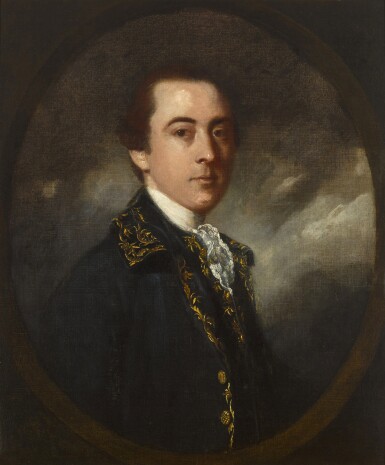
Portrait of a man in a blue embroidered coat and lace cravat, in a painted oval
Auction is live
Waiting for auctioneer to open lot
Estimate
10,000 - 15,000 GBP
Bid
10,000 GBP
Lot Details
Description
Property from a Private Collection
Sir Joshua Reynolds, P.R.A.
Plympton, Devon 1723–1792 London
Portrait of a man in a blue embroidered coat and lace cravat, in a painted oval
oil on canvas
unframed: 76.6 x 63.5 cm.; 30⅛ x 25 in.
framed: 95.1 x 82.5 cm.; 37⅜ x 32½ in.
Charles Fairfax Murray (1849–1919), London;
By whom sold ('The Property of C. Fairfax Murray, Esq.'), London, Christie's, 14 December 1917, for £546 to Marshall;
Where acquired by Alfred Chester Beatty (1875–1968), Calehill Park, Kent;
By whose Executors sold ('The Property of the late Sir A. Chester Beatty'), London, Sotheby's, 20 November 1968, lot 66, for £750;
Private collection, Lancashire;
Whence sold, Macclesfield, Adam Partridge Auctioneers and Valuers, 20 February 2020, lot 682 (as manner of Sir Joshua Reynolds);
Where acquired by the present owner.
Canterbury, Tower House, Catalogue of an Exhibition of Old Masters from Houses in Kent, 11 June – 8 July 1937, no. 41 (as lent by Alfred Chester Beatty, Esq).
E.K. Waterhouse, Reynolds, London 1941, p. 106;
D. Mannings, Sir Joshua Reynolds. A Complete Catalogue of his Paintings, 2 vols, New Haven and London 2000, vol. I, p. 497, no. 1992, vol. II, p. 275, fig. 520, reproduced (dated circa 1760).
Note on Provenance
This elegant portrait was first recorded in the collection of Charles Fairfax Murray, an English painter, collector, connoisseur, and one of the most significant art agents of the late nineteenth century. Closely associated with the Pre-Raphaelites—first as Edward Burne-Jones’s studio assistant and later as a trusted collaborator of William Morris—Murray developed an exceptional eye for Old Master paintings and early Italian art. By the 1870s and 1880s he had established himself as a highly respected advisor and dealer, supplying important works to institutions such as the National Gallery, the Fitzwilliam Museum, and the Birmingham Museum and Art Gallery.
This work later entered the celebrated collection of Alfred Chester Beatty, an American-born mining magnate, bibliophile, and one of the twentieth century’s most discerning collectors of rare books, manuscripts, and works of art. After achieving great success in the mining industry, he settled first in London and later in Dublin, where his collecting activities reached their fullest expression. Beatty’s tastes were wide-ranging, but he became especially renowned for his acquisitions of Islamic, East Asian, and Western medieval manuscripts, assembling one of the world’s finest private libraries.
You May Also Like


