
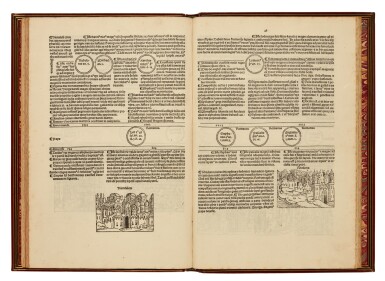
Werner Rolewinck | Fasciculus temporum, Venice, 1484
Lot closes
December 11, 02:52 PM GMT
Estimate
6,000 - 8,000 GBP
Starting Bid
4,500 GBP
We may charge or debit your saved payment method subject to the terms set out in our Conditions of Business for Buyers.
Read more.Lot Details
Description
Werner Rolewinck
Fasciculus temporum. Venice: Erhardus Ratdolt, 28th May 1484
Small folio (298 x 194mm.), 55 woodcuts (including repeats), diagrams, white-vine intaglio woodcut initials, early twentieth-century red morocco gilt, housed in a red morocco cloth slipcase and chemise
A FINELY BOUND, ATTRACTIVE EXAMPLE of Werner Rolewinck’s chronology Fasciculus temporum, translated as “Little bundles of time”. One of the most popular books of the late fifteenth century, Rolewinck's Fasciculus was first printed in its approved form in Cologne in 1474 (although there may have been a piracy of 1473 produced from a different press in the same city). The work presents both ecclesiastical and secular world history, from Genesis (in 5199 BCE) to 1475, in the reign of Pope Sixtus IV, and with the story of Charles the Bold of Burgundy.
Erhard Ratdolt's page design succinctly compared the relative importance of each historical episode with the great events of Christianity, by dividing each page into biblical and ecclesiastical history above, and secular history below, using a horizontal woodcut strip. While earlier editions contained diagrams, Ratdolt also included a woodcut map of the world for the first time, with Jerusalem at its centre, and Palestine as a distinct region. Also included is a woodcut of Venice: the second earliest printed depiction of the city, clearly showing the Doge’s Palace and gondolas. The views of England, Jerusalem, and Rome, amongst others, are the earliest obtainable depictions of these cities.
Werner Rolewinck (1425–1502) was born in Westphalia in 1425, and entered the Carthusian monastery of St Barbara in 1447, where he lived all his life. He may have written more than fifty works, but the Fasciculus temporum remains his best known. The work was an instant success, and more than thirty editions were published over the following century. It also greatly influenced Hartmann Schedel’s Liber cronicarum (1493), now better known as the Nuremberg Chronicle.
PROVENANCE:
Roberto Salinas Price (1938–2012), Biblioteca Huicalco, Mexico, 1977, bookplate. Salinas was a Mexican industrialist with an interest in Homeric legends, about which he published several works.
LITERATURE:
ISTC ir00270000; Goff R270
You May Also Like

![[Patent of nobility] Carta executoria for Alonso Morillo, Granada, 1576, manuscript on vellum, contemporary Granada binding of black morocco gilt](https://dam.sothebys.com/dam/image/lot/018b201f-7f2c-4794-9668-2656908b5c2e/primary/extra_small)


![MINHAGIM, SIMEON HA-LEVI GÜNZBURG, AMSTERDAM: ELIJAH ABOAB [AND MENASSEH BEN ISRAEL], 1645](https://dam.sothebys.com/dam/image/lot/a4242e18-268b-4827-8723-05a9dfee0d48/primary/extra_small)

