
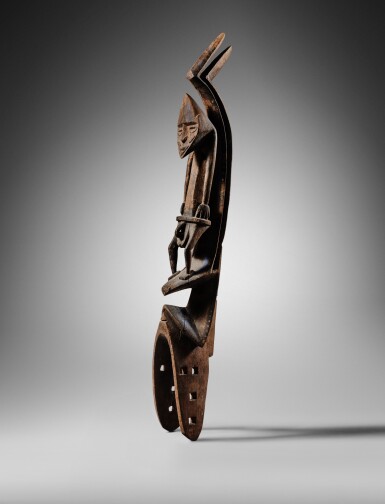
Solip or Solub Canoe Prow, Vao or Atchin Islands, Malekula Island
Lot closes
December 10, 04:16 PM GMT
Estimate
12,000 - 18,000 EUR
Starting Bid
7,000 EUR
We may charge or debit your saved payment method subject to the terms set out in our Conditions of Business for Buyers.
Read more.Lot Details
Description
Solip or Solub Canoe Prow, Vao or Atchin Islands, Malekula Island
Haut. 121 cm ; Height. 47 ⅝ in
Mission Adventiste, SDA, Îlot d'Atchin, Vanuatu
Nivolaï Michoutouchkine (1929–2010), Port Vila, Vanuatu, acquired from the above between 1961 and 1963
Collection Borg Johannson, Auckland, New Zealand
Wayne Heathcote Gallery, London
American Private Collection, Texas, acquired from the above in 2014
French Private Collection
Wayne Heatchcote Gallery, San Francisco Tribal Art Fair de 2014
This wooden prow ornament once crowned the front of an outrigger canoe, known as a naho. It comes from the islet of Vao or Atchin, off the northeast of the Malekula island, where such objects are known as solip or solüb. The cultures of the small islands of northeast Malekula — Vao, Atchin, Wala, Rano, Uripiv and Uri — are the only ones in Vanuatu to produce detachable prow figures carved as animals (generally birds) or human figures. They signified the social rank of the canoe’s owner or of a ritually affiliated group within the local male hierarchy known as the “Maki”.
In 1947, Georges Condominas devoted a study to the watercraft of what were then called the New Hebrides - and not yet Vanuatu. He wrote about these prow figures that “the typical motif is a bird with a remarkably stylised beak and wings, which according to ornithologist Harrisson may be either a frigatebird or a petrel — both of great importance in Kanak mythical life. When another element is added, it is always of at least equal importance: man or pig, and indicative of a higher rank…”[1]
In this respect the piece at hand is remarkable: the presence of an anthropomorphic figure signals the elevated status of its owner. Ethnographer Joël Bonnemaison underlined the essential role of the canoe within lineage structures: The Melanesian canoe is intended to extend this alliance all the way to the furthest reaches of infinity, marked by the routes throughout its territory. This horizon never closes on itself; the link it projects is an endless one.”[2]
The sculptural quality and elaborate design combining a bird and a human figure attest to the importance attached to this figure and the vessel it adorned. It can be compared to a similar prow, possibly by the same sculptor, now held in the Barbier-Mueller Museum (inv. No 4611)[3].
[1] Condominas, G., Esquisse d’une étude sur la navigation et la pêche aux Nouvelles-Hébrides, 1947, publ. in Documents scientifiques et techniques, No III 4, May 2001, pp. 11-13
[2] Bonnemaison J., Vanuatu Océanie : arts des Îles de cendre et de corail, 1996, p. 38
[3] Huffman, K., Arts d’Afrique et d’Océanie. Fleurons du musée Barbier-Mueller, Genève, 2007, p. 350 and Arts des Mers du Sud. Insulinde, Mélanésie, Polynésie, Micronésie, collections du Musée Barbier-Mueller, Paris, 1998, p. 287, fig. 4
You May Also Like


