
Benjamin Franklin | A recommendation betrayed … and eventually redeemed
Live auction begins on:
June 24, 06:00 PM GMT
Estimate
20,000 - 30,000 USD
Bid
12,000 USD
Lot Details
Description
Benjamin Franklin
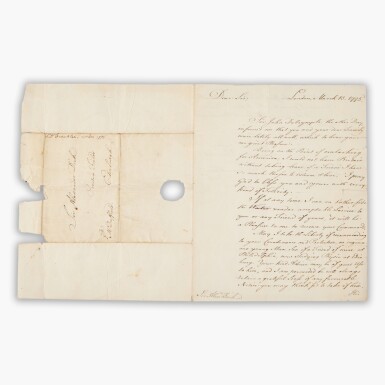
Autograph letter signed ("BFranklin") to Alexander Dick (“Dear Sir”), 1½ pages (230 x 183 mm) on a bifolium of laid paper (watermarked JWhatman&Co), London, 13 March 1775, announcing his return to America and introducing the son of an old friend, integral leaf with autograph address panel (“Sir Alexander Dick | Preston Fields | Edinburgh | per Mr. Duffield”) and reception docket (“Dr. Franklin, London, 1775”); fold separations, seal tear, seal neatly excised, address leaf very lightly soiled. Half blue morocco folding-case gilt, chemise.
Writing to one of his closest friends in Scotland, Franklin reveals his impending departure for Philadelphia after nine years' residence in London:
“Sir John Dalrymple the other Day inform'd me that you and your dear Family were lately all well, which to hear gave me great pleasure.” (Sir John Dalrymple of Cousland, a significant figure in the Scottish Enlightenment, was an advocate, judge, author, and co-founder of the Royal Society of Edinburgh.)
“Being on the Point of embarking for America, I would not leave Britain without taking Leave of a Friend I have so much Reason to esteem & love. I pray God to bless you and yours with every kind of Felicity.—
“If at any time I can on t’other side of the Water render acceptable Service to you or any Friend of yours, it will be a Pleasure to me to receive your Commands.”
In closing Franklin introduces Benjamin Duffield, who carried this letter to Dr. Dick. Benjamin was the son of Franklin’s old friend Edward Duffield, a noted Philadelphia clockmaker and engraver, member of the American Philosophical Society and the Philadelphia Committee of Correspondence, and Franklin’s executor. The younger Duffield had recently completed his course work at the College of Philadelphia and gone to Edinburgh to study medicine.
“May I take the Liberty of recommending to your Countenance and Protection, an ingenious young Man, son of a Friend of mine at Philadelphia, now studying Physics at Edinburg. Your kind Advice may be of great Use to him, and I am persuaded he will always retain a grateful Sense of any favourable Notice you may think fit to take of him. His name is Duffield, and he will have the Honour Of presenting this to your hands.”
After a particularly earnest valediction (“With sincere Affection & Attachment, I am ever Dear Sir, Your obliged & most obedient humble Servant”), Franklin adds a brief postscript regarding another Scottish physician, Sir John Pringle, the author of Observations on the Diseases of the Army in Camp and Garrison (1752), whose work focused on the role of sanitation in preventing the spread of disease: “Our friend Sir J Pringle Was well last evening.”
Franklin himself had been introduced to Benjamin Duffield by Thomas Potts, a Philadelphia-area iron manufacturer, assemblyman, and Continental Army officer, who wrote to Franklin on 1 August 1774, “I have often recollected your kind farewell and kindness when you last left Chester when you desired I might make use of your Assisstance in any Matter I had to doe in London. … My friend Mr. Duffield’s son Ben is going to Edenbourough to improve himself in his profession of Phisick by whom I write this and he promises to send by some friend from there. If he should ever have the pleasure of seeing you in London you will easyly discover Merit in him” (Papers 21:268–269).
Franklin found enough merit in the medical student to not only write the present letter of introduction to Dr. Dick, but also to send a very similar missive to Lord Kames the next day (see following lot). But, in the short run, at least, Franklin’s confidence in the young man was misplaced. Duffield apparently entered a period of dissipation and was essentially disowned by his parents; in May 1779, then in Bordeaux, he wrote Franklin an excruciatingly supplicating letter seeking assistance in repairing his family relationships and finding the means to return to Philadelphia (and trying to draw a none-too-subtle comparison between his father’s parochial nature and Franklin’s more worldly outlook).
“You will probably be much surprized at receiving a Letter from this Place, and from one who has so much disgraced the Introduction you were so kind as to favour him with. I cannot without deep Confusion, attempt to address you again—I cannot attempt to excuse my past follies and Indiscretions otherwise than by pleading a natural Volatility and a great flow of Animal Spirits. These joined to Youth and Health hurried me into Imprudencies that I have since severely repented of. I have bought Experience dearly. Distress and Necessity have taught me a Lesson that I never, never shall forget: and I am now by my regular Conduct, and prudent behaviour, endeavouring to regain that Reputation that I once enjoyed. … I was within a few Days of sailing, when I received a small Bill from my father—with a Letter strongly marked with that cool Inflexibility for which you my dear Sir well know he is so remarkable. Indeed he has Reason to be much offended—but his Education being much confined, and his Ideas of Men and Things not the most liberal, he magnifies my offences. … If you do not think me quite unworthy your Notice—if you have any Compassion for my unhappy situation, may I request the favour of your advice. I look upon your Character as sacred, & as I am shut out from Parents and all that I hold dear, and that once held me high in their affection and Esteem, will you condescend to mark out a Line for my Conduct which I promise most religiously to observe. I have seen my Errors in the strongest Light, and will endeavour to make my future Conduct as bright as my faults were deep before” (Papers 29:504–506).
Franklin evidently never replied; however, Benjamin Duffield did regain his equilibrium and make good on his pledge to reform. He managed to gain passage back to Pennsylvania, where he served as a surgeon in a military hospital in Reading for the remainder of the Revolution, afterwards opening a flourishing private practice in Philadelphia. In 1787 he became a founding member of the College of Physicians of Philadelphia, having the previous year been elected to the American Philosophical Society. Duffield worked at the hospital at Bush Hill during the 1793 Philadelphia yellow fever epidemic and was also an attending physician at the Walnut Street prison.
REFERENCES
Not in Papers of Benjamin Franklin and apparently unpublished; the above is the first fully accurate transcription of the text.
PROVENANCE
Lyon and Turnbull, 11 July 2006, lot 274 (undesignated consignor; likely a descendant of the recipient) — Profiles in History, 15 November 2012, lot 28 (undesignated consignor)
You May Also Like


