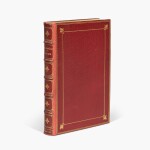
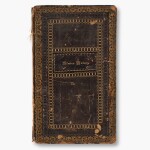
H. Rider Haggard | She, 1886, page proofs with authorial corrections
Estimate
6,000 - 8,000 GBP
We may charge or debit your saved payment method subject to the terms set out in our Conditions of Business for Buyers.
Read more.Lot Details
Description
H. Rider Haggard
She. PAGE PROOFS WITH EXTENSIVE AUTHORIAL CORRECTIONS AND FINAL TEXTUAL REVISIONS THROUGHOUT, textually complete (without preliminaries), printer's date stamps (10 and 12 November 1886) and with dates added in manuscript at intervals presumably recording when sections were returned to the printer (16 to 19 November 1886), 8vo (140 x 200 mm), brown half roan on patterned boards, housed in a collector's slipcase and box, first leaf browned and with adhesive residue at gutter, page edges frayed, some staining including ink stains from the printing house
THE FINAL STAGE IN THE PRODUCTION OF ONE OF ONE OF THE GREAT VICTORIAN ADVENTURE STORIES: THE QUEST FOR REVENGE AGAINST "SHE-WHO-MUST-BE-OBEYED". Rider Haggard's early career had been as a colonial administrator and lawyer, but She, following shortly after King Solomon's Mines (1885), cemented his reputation as a great popular story-teller of imperial Britain:
"...he wrote [She] in just over six weeks, done, as he put it, 'at white heat, almost without rest… it came faster than my poor aching hand could set it down'. When it was ready, he took it to his recently acquired agent, slammed it down on the table, and proclaimed, 'There is what I shall be remembered by' (Days of my Life, 1.245–6). The novel was a succès fou and made Haggard and his heroine, Ayesha, household names. He gave up the law and wrote full time, producing at least a book a year until his death..." (ODNB)
She first appeared in The Graphic, October 1886–January 1887. The current proofs are for the first edition in book form, which was printed in December 1886 by Spottiswoode and Co. for Longmans, Green and Co. for publication in January 1887. The edition of 10,000 copies sold out almost immediately; another 15,000 copies were printed in January 1887 and 5000 in March 1887.
LITERATURE:
Whatmore, F4