
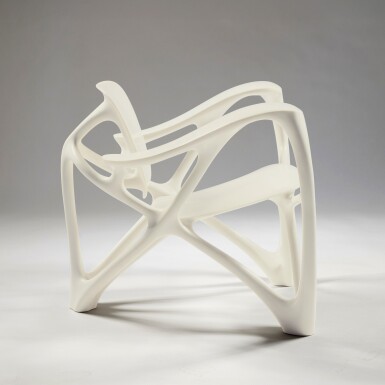
Property from an Important American Collection
Joris Laarman
"Bone" Armchair
Live auction begins on:
January 31, 04:30 PM GMT
Estimate
150,000 - 200,000 USD
Bid
120,000 USD
Lot Details
Description
Property from an Important American Collection
Joris Laarman
b. 1979
"Bone" Armchair
signed Joris Laarman and numbered 7/12 (on the underside)
Carrara marble powder, casting resin
73 by 98.4 by 78.7 cm.
28 ¾ by 38 ¾ by 31 in.
Executed in 2008 by Joris Laarman Lab, Amsterdam, The Netherlands, this is number 7 from an edition of 12 plus 3 artist's proofs and 1 prototype.
Friedman Benda, New York
Acquired from the above in 2008 by the present owner
Exh. Cat., Groningen, Groninger Museum, Joris Laarman Lab, 2015, pp. 74-75 and 94-101
Exh. Cat., New York, Cooper Hewitt, Smithsonian Design Museum, Joris Laarman Lab, 2017, pp. 64-65, 82-89 and 313
Joris Laarman’s groundbreaking design philosophy shines through in the “Bone” Armchair, a distinguished example of his “Bone Furniture” series that interrogates the intersections between man-made and natural design. In the present work, Laarman utilized an algorithm that emulates the growth structure found in bones and trees — “I use the algorithm as a sculptural tool the way a sculptor would use a hammer and chisel” — adding mass to pressure points and taking away from areas that need less physical support. After graduating from the Design Academy in Eindhoven in 2003, Laarman and his partner Anita Star founded Joris Laarman Lab, where the artist and his cohort of coders, engineers, designers, and artisans explore the intersections of the digital and the physical. Laarman’s unique design philosophy, beautifully emblematized in the present work, has found his works housed in prestigious institutional collections such as the Art Institute of Chicago; the Centre Pompidou, Paris; The Museum of Modern Art, New York; the Stedelijk Museum, Amsterdam; and the High Museum, Atlanta. Executed with exquisite deftness that pares the armchair down to its most essential forms, Laarman’s “Bone” Armchair captures his philosophy of “high-tech Art Nouveau” with an indelible sense of elegance and beauty.
The present work is a particularly significant example within Laarman’s oeuvre, as the designer himself described: “If evolution had wanted to create a chair, then it would look something like that.” The “Bone” Armchair marks the first “Bone” model that used 3D printing in its cast, its marble surfaces gleaming in a skeletal white sheen. This digital engineering is central to Laarman’s practice, where, through a unique design sensibility, utilitarian objects become explorations of cutting-edge technology. The result is an armchair that foregrounds both mechanical precision and an ambitious artistic vision – one that is both deeply futuristic yet quintessentially human. To these ends, Laarman’s construction of the present “Bone” Armchair reaches the self-possessed elegance resonant throughout his entire body of work.


