
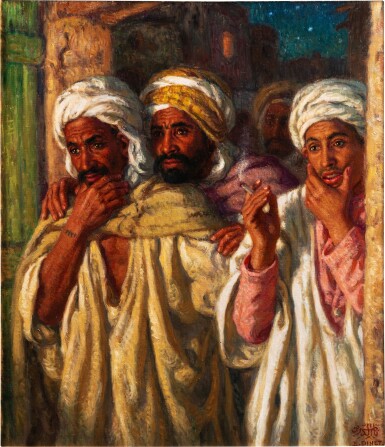
Property from a French Private Collection
Nasreddine (Etienne) Dinet
A Captive Audience
Estimate
50,000 - 70,000 GBP
Lot Details
Description
Property from a French Private Collection
Etienne DINET
French
1861 - 1929
A Captive Audience
signed E. DINET. and in Arabic lower right
oil on canvas
Unframed: 75.3 by 65.4 cm., 29⅝ by 25¾ in.
Framed: 91 by 81 cm., 35⅞ by 31⅞ in.
Paris, Institut du Monde Arabe, Etienne Dinet, passions algériennes, 30 January-15 September 2024
A Captive Audience is a superb example of Dinet's mature oeuvre, testament to his intimate knowledge of, and respect for, the people of Algeria. Fluid, almost Impressionistic brushstrokes are coupled with a masterful observation of firelight illuminating the expressive faces of four men as they witness a traditional dance by local Ouled Naïl girls.
Dinet took great interest in painting the women of Algeria in their traditional dances, particularly the dancers of the Ouled Naïl tribe. Here, however, the focus is entirely on the male onlookers’ faces, leaving the viewer to imagine the rest of the scene. As in Dinet’s best works, the composition, with the figures occupying the entire frame, feels naturalistic and uncontrived, suggesting the influence of photography on the artist’s work.
Dinet's fascination with Algeria dated from his first visit in 1883. This proved to be a turning point in his career: he returned virtually every summer thereafter, visiting the capital and oasis towns of Bou Saâda, Biskra and Laghouat. In 1904 the artist acquired a house in Bou Saâda, the closest of the oasis towns to Algiers some 150 miles south-east of the capital, choosing to settle there permanently.
In his commitment to the places and people of Algeria, Dinet immersed himself in the life of Islamic north Africa more than virtually any other Orientalist artist. Dinet spoke Arabic fluently, and his interest in Islam became increasingly evident in his paintings. In 1913 he converted to Islam, and changed his name to Nasreddin ('Defender of the Faith'). In 1929 Dinet went on the Hajj with his friend Slimane Ben Ibrahim.
More than anything Dinet intended his paintings to be faithful, as well as beautiful, records of the vicissitudes of daily life as experienced by the people of the Algerian oasis towns. Dinet’s paintings are important depictions of the life of the local people by an observer who became part of their world.
You May Also Like


