Property from a Belgian Private Collection
Gérard de Lairesse
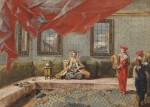
Apelles painting the portrait of Campaspe
Live auction begins on:
July 2, 10:00 AM GMT
Estimate
40,000 - 60,000 GBP
Bid
28,000 GBP
Lot Details
Description
Property from a Belgian Private Collection
Gérard de Lairesse
Liège 1641–1711 Amsterdam
Apelles painting the portrait of Campaspe
signed lower left: G. Lairesse
signed with monogram below: GL (in ligature)
oil on canvas
unframed: 84 x 99.5 cm.; 33⅛ x 39⅛ in.
framed: 100 x 116.4 cm.; 39⅜ x 45⅞ in.
Possibly Pieter van der Lip (1655–1712), Amsterdam;
Possibly his posthumous sale, Amsterdam, 14 June 1712, lot 1 ('Daar de Keyser Alexander zyn Liesste overgeeft aan Apelles, den vermaarde Schilder, konstig geschildert en cierlyk verbeeld in een Paleys, door Gerard de Larisse');
Possibly Jan Smees (c. 1670–1729), Amsterdam;
Possibly his posthumous sale, Amsterdam, 6 April 1729, lot 1 ('Een stuk, daar Alexander Campaspe aan Apelles overgeeft, door Gerard Lairesse, een uytvoerig en capitaal stuk, in 't beste van zyn tyd geschildert');
Dr F. Koser, Berlin;
His posthumous sale, Berlin, Keller and Reiner, 6–7 March 1906, lot 40;
Anonymous sale, Munich, Neumeister, 20 September 1978, lot 1200 (as circle of Gérard de Lairesse);
Anonymous sale, London, Sotheby's, 5 April 1995, lot 186;
Subsequently acquired by the present owner.
Enschede, Rijksmuseum Twenthe, Finally! De Lairesse, 10 September 2016 – 22 January 2017, no. C94.
Possibly A. Roy, Gérard de Lairesse (1640–1711), Paris 1992, pp. 490–91, M. 70 (the Pieter van der Lip sale) and M. 104 (the Jan Smees sale);
J. Beltman, P. Knolle, and Q. Van der Meer Mohr (eds), Eindelijk! De Lairesse. Klassieke schoonheid in de Gouden Eeuw, exh. cat., Entschede 2017, p. 167, no. C94, reproduced in colour;
C. Dumas, 'Enkele opmerkingen over achttiende-eeuwse "vertaaltekeningen", met een uitstapje naar Jan Matthias Cok', in Delineavit et Sculpsit, no. 48, April 2021, pp. 69–70, reproduced in colour fig. 56.
Campaspe was the favourite concubine of Alexander the Great who, desiring to have her beauty immortalised, commissioned Apelles, the greatest of all classical artists, to paint her portrait. The resulting long-lost picture was said to be both erotic and virtuous, and delighted Alexander to such an extent that he resolved to give Campaspe to Apelles, who had fallen in love with the girl as he painted her. The story of Alexander, Apelles and Campaspe, recounted by Pliny the Elder in Book XXXV of the Natural History, has been interpreted as an apocryphal allegory of Alexander’s generosity. The subject appealed to artists who wished to be identified with the famed Apelles, creating beautiful imagery and being honoured as a result. It also appealed to the powerful patron, who liked to imagine himself as a world ruler and magnanimous sponsor of the arts. Because no other painting of this subject by De Lairesse is known, it is probable that this is the picture sold in the Van Der Lip and Smees sales (see Provenance).
You May Also Like