
Abraham Bloemaert
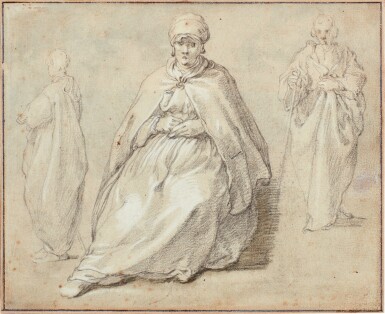
Recto: A sitting woman, seen from the front; and two standing men; Verso: Three standing young men in wide cloaks
Lot closes
April 15, 01:23 PM GMT
Estimate
6,000 - 8,000 GBP
Starting Bid
5,000 GBP
We may charge or debit your saved payment method subject to the terms set out in our Conditions of Business for Buyers.
Read more.Lot Details
Description
Abraham Bloemaert
Gorinchem 1566–1651 Utrecht
Recto: A sitting woman, seen from the front, and two standing men
Verso: Three standing young men in wide cloaks
numbered in brown ink on the recto, top left corner: 72
recto: black chalk, heightened with white chalk, with light blue wash, within brown ink framing lines
verso: black chalk, heightened with white chalk
151 by 185 mm
Possibly Cornelis Bloemaert the Younger (1603-1692),
possibly Arnold van Westerhout (1651-1725), Rome,
possibly Nicolas Vleughels (1668-1737), Rome,
possibly with Académie de France, Rome (as suggested by Jean-François Méjanès);
Anonymous Paris art dealer, c. 1903;
with Kurt Meissner, Zürich by 1970;
with Katrin Bellinger, Munich, 1990, no. 23, reproduced;
sale, Amsterdam, Christie's, 9 November 1998, no. 34;
sale, Berlin, Galerie Bassenge, 25 November 2016, lot 6525
J. Bolten, Abraham Bloemaert c.1565-1651, The Drawings, 2 vols, Leiden 2007, vol. I, p. 322, no. 982 (verso), no. 983 (recto), reproduced vol. II, p. 362, fig. 982 (verso), p. 363, fig. 983 (recto)
This charming double-sided sheet of studies was possibly among the substantial number of drawings by Abraham Bloemaert that his son Cornelis Bloemaert the Younger took with him when departing Ultrecht for Paris, and subsequently for Rome, in 1630, with the goal of turning them into engravings for a Tekenboek. This theory was proposed by Jean-François Méjanès in his 2001 article,1 where he further suggests that after Cornelis’ passing, the drawings – which Cornelis never did translate into print – first passed to Arnold van Westerhout, a Flemish artist, printmaker and publisher, and then to the director of the French Academy in Rome, Nicolas Vleughels, who kept a modest collection of drawings at the academy for the students to copy.
Two artists who did so were François Boucher (1703-1770) and Pierre Subleyras (1699-1749), during their time at the academy in the years between autumn 1728 and spring 1731. A drawing after the seated female figure from the present sheet (recto) by Subleyras is at the Musée des Beaux-Arts, Lyon.2
Although Méjanès’ suggestions regarding the early provenance seem highly plausible, it should, however, be noted that in his catalogue raisonné of Bloemaert’s drawings (see literature), Jaap Bolten expressed doubts regarding Méjanès’ theory, pointing out that a number of the Bloemaert drawings that were engraved by Boucher remained in the artist’s studio when Cornelis departed for Paris.
While Subleyras replicated the female figure seen on the recto, Bloemaert himself reused the central male figure from the verso, repeating the study with only slight modifications to the left side in drawing no. 104 of the so-called Cambridge Album, in the collection of the Fitzwilliam Museum in Cambridge.3
1. See J.-F. Méjanès, 'un exercise hors règlement: Bloemaert, Boucher et Subleyras ... mais pas Natoire', Mélanges en hommage à Pierre Rosenberg. Peintures et dessins en France et en Italie XVIIe - XVIIIe siècles, Paris (Réunion des Musées Nationaus) 2001, passim
2. Ibid., p.306, fig. 12
3. Inv. no. PD 166-1651; J. Bolten, no. 1253
You May Also Like


