Property from an Important British Collection
Edward Burra
Picking a Quarrel
Estimate
50,000 - 80,000 GBP
Lot Details
Description
Edward Burra
1905 - 1976
Picking a Quarrel
stamped with artist's stamp (lower right)
watercolour on paper
unframed (sheet): 79 by 133 cm. 31 by 52 in.
framed: 95 by 150 cm. 37½ by 59 in.
Executed in 1968-9.
Estate of Edward Burra
Lady Ritchie of Dundee and Associated Owners
Sotheby's London, 3 July 2002, lot 302
Acquired by the present owner
London, Lefevre Gallery, Recent Works by Edward Burra, 1969, no. 8, illustrated
London, Olympia Fine Art and Antiques Fair, Loan Exhibition: Edward Burra 1905 - 1976, 27 February - 4 March 2001, no. 17
London, Crane Kalman Gallery, England Landscape of the 20th Century, July 2004
Chicester, Pallant House Gallery, Edward Burra, 22 October 2011 - 19 February 2012, no. 148, illustrated p. 162
London, Tate Britain, Edward Burra, 13 June 2025 - 19 October 2025
Andrew Causey, Edward Burra: A Complete Catalogue, Phaidon, Oxford, 1985, no. 348, illustrated
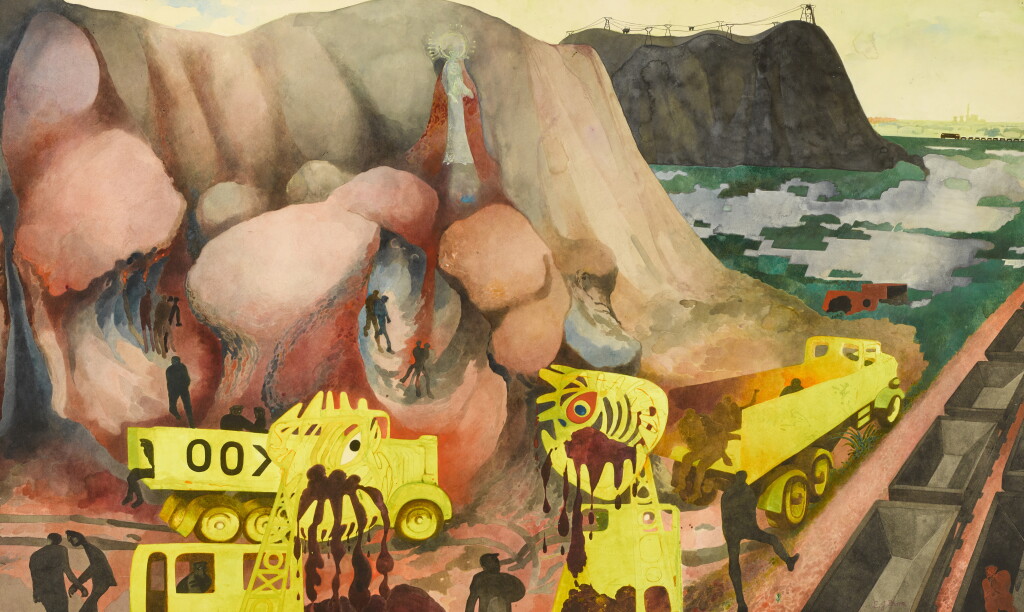
Picking Quarrel, executed in 1968/9, is an iconic example of Edward Burra’s assured, more mature output.
Following the war, Burra’s travels became more limited, largely as a result of his ill health, and he instead explored Britain and Ireland, particularly the rugged landscapes of Cornwall and the Lake District. He became increasingly drawn to scenes of natural beauty and its destruction and moved away from his focus of painting people. In the aftermath of the postwar industrial revolution, Burra lamented the damage inflicted on the countryside, as seen in the present work, where monstrous diggers excavate a mountain, and in Cornish Clay Mines, painted just one year later, depicting mine shafts and a petrol station.
Here, shadowy men scale the cliff, while vibrant trucks trundle alongside them, obscured by what appear to be drips of red. Above them, a saintly figure hovers, presiding over the scene with a sense of power – or is it one of helplessness? From the figure’s halo streams red, and either way, the work is resplendent with irony.
Whilst some passages evoke the style of Burra’s earlier output, such as the iconic flattened perspective and watercolour – like painterly areas on the right, the colour here seems remarkably vibrant – in stark contrast to the imagery of desolation within the present work.
Burra’s later paintings of war and environmental destruction seem particularly resonant now, both so deeply intricate and so devastating. Picking Quarrel has been widely exhibited, including at Pallant House and, more recently, in the highly acclaimed Burra exhibition at Tate, underscoring its significance within Burra’s oeuvre and its importance as a brilliant example from this period.
You May Also Like