A New Vista: The David and Shoshanna Wingate Collection
Bernard Meadows
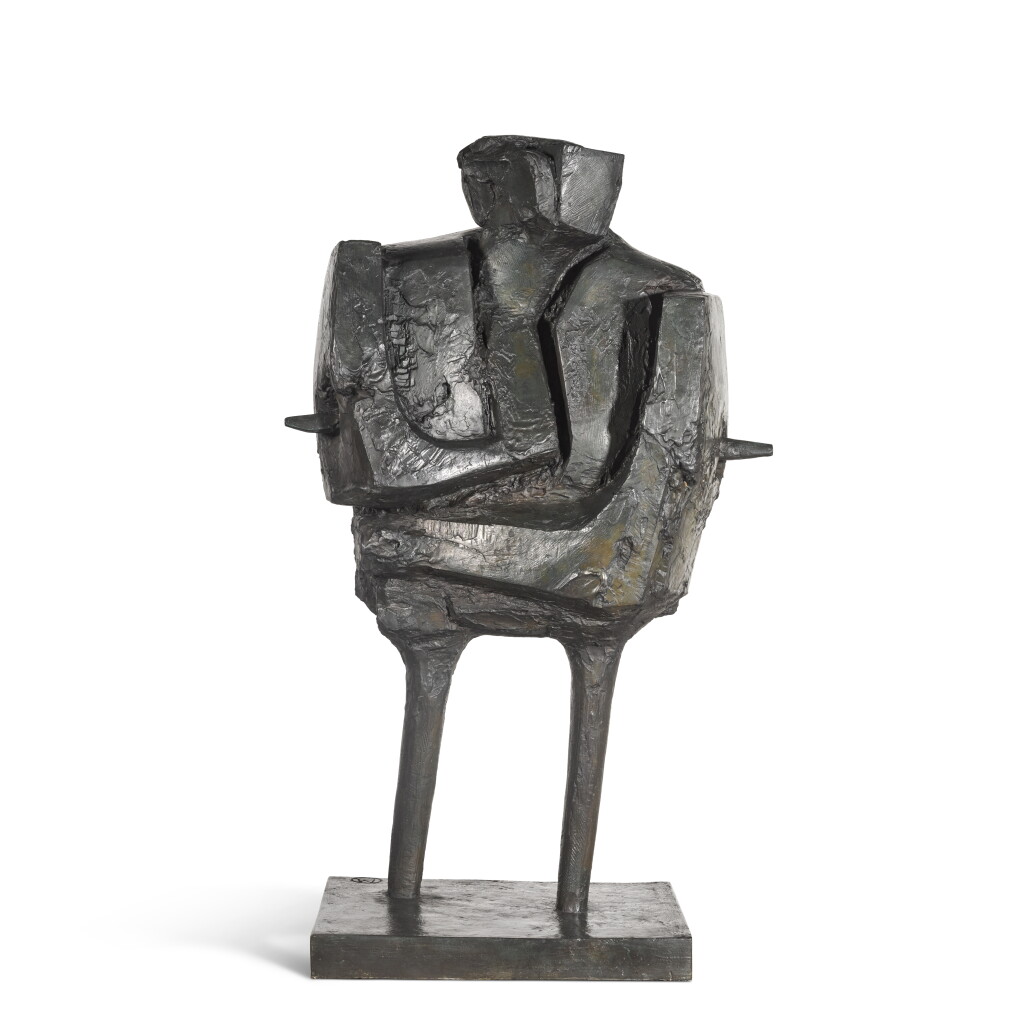
Large Standing Armed Figure
Estimate
40,000 - 60,000 GBP
Lot Details
Description
Bernard Meadows
1915 - 2005
Large Standing Armed Figure
signed with monogram (on the base)
bronze
height: 170.5 cm. 67⅛ in.
Conceived and cast in 1962, the present work is from an edition of 3.
Gimpel Fils, London
Austin Briggs, New York
Sale, Sotheby's, New York, 24 October 1974, lot 380, where acquired by the present owner
London, Battersea Park, Sculpture in the Open Air, 1963, no. 28
Venice, XXXII Venice Biennale, British Pavilion, 20 June - 18 October 1964, with British Council tour to Stedelijk Museum, Amsterdam; Moderna Galerija, Zagreb; Kunstamt Reinickendorf, Berlin; Museen der Stadt, Recklinghausen and the Kunstverein, Braunschweig
Alan Bowness, Bernard Meadows, Sculpture and Drawings, The Henry Moore Foundation in association with Lund Humphries, London, 1995, no. BM 86, illustrated pl. 50, p. 69
Bernard Meadows studied at the Norwich School of Art from 1934-6, and later became Henry Moore’s first assistant. Moore went on to become a close friend and mentor and indeed Meadows took great inspiration from the older artist's work initially, with his early work resembling that of Moore’s, with undulating forms and perfectly smooth surfaces. By the 1960s, however, Meadows had departed artistically from his mentor, having found a distinct style of his own. This can be clearly seen in the present lot, Large Standing Armed Figure.
Bernard Meadows was one of the artists whose work was described by Herbert Read as capturing the 'Geometry of Fear', a term he coined in 1952 when reviewing the British pavilion at the Venice Biennale where Meadows was exhibiting work alongside that of his contemporaries including Kenneth Armitage, Lynn Chadwick and Reg Butler. Moreover, geopolitical tensions were to rise further against the backdrop of the Second World War as the 1950s and 60s progressed, and this work reflects intimately the increasing hostility that beset the world's stage at this time. 1962 formed the very peak of the Cold War, with the Cuban Missile Crisis taking the United States and Soviet Union closer to nuclear war than at any other time in history.
Created the very same year, in Large Standing Armed Figure Meadows sculpts a rough, visceral form that stands resolute against attack. One may also draw parallels to his earlier motif of the crab - including his Black Crab of 1952 - and he described these creatures as “vehicles expressing [his] feelings about humans”. Here he seems to make a human almost crab-like, it's hard shell transmuted into the hunched monolithic back of the armed figure. His contemporary in the Geometry of Fear group, Lynn Chadwick, also began to deconstruct human forms into coarse block-like shapes, making them into more simplified archetypes, with featureless faces.
This life-size bronze is imposing and powerful, the figure’s heavy body almost precarious upon two spindly legs. A spear-like form juts out from either side of its torso. This antagonistic, sharp bronze is characteristic of Meadow’s work at the time, reflecting a collective unease that can be seen across the sculptures produced by him and his peers.
Meadows was a master of contrast in his sculptures, and here the jutting forms of the figure's arms which appear to be encased in armature is contrasted with a harsher texturing of the surface, and the sharp points of the spears. This contrast extends to the subject too; one gets a sense of the protective nature of the figure, hunched in on itself and with crossed arms, not directly attacking but perhaps in a self-comforting gesture. Its legs are skeletal and rooted into the base, as if frozen to the spot. Capturing the essence of its time, the sculpture is universal in its relevance, as impactful today as when it was created.
You May Also Like