Property from an Australian Collection
Ivon Hitchens
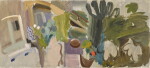
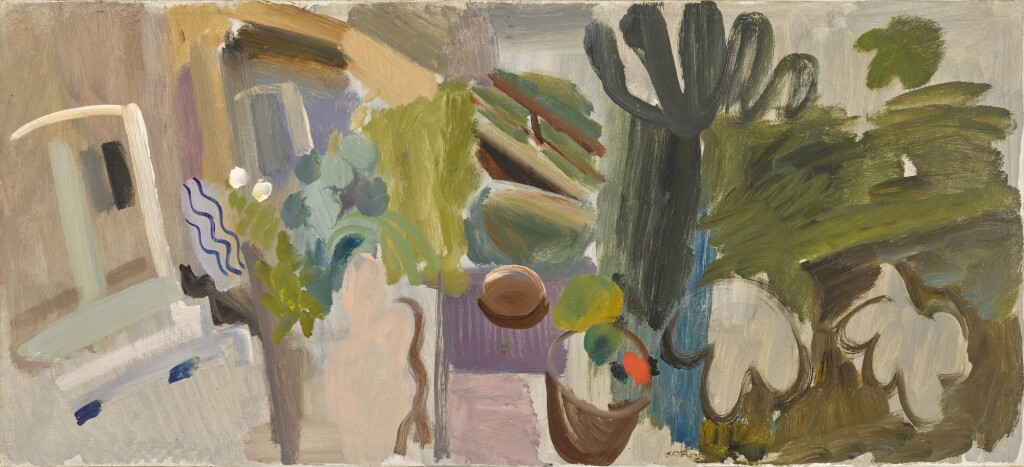
Figure, Courtyard – Greenleaves
Estimate
60,000 - 80,000 GBP
Lot Details
Description
Ivon Hitchens
1893 - 1979
Figure, Courtyard – Greenleaves
signed Hitchens (lower centre right)
oil on canvas
unframed: 46 by 101 cm. 18 by 39¾ in.
framed: 65.5 by 120 cm. 25¾ by 47¼ in.
Executed circa 1935-40.
We are grateful to Peter Khoroche for his kind assistance with the cataloguing for the present work.
Estate of the Artist
Jonathan Clark & Co., London
Private Collection, Australia
‘My pictures are painted to be "listened" to… I should like things to fall into place with so clear a notion that the spectator’s eye and "aesthetic ear" shall receive a clear message, a clear tune. I seek to recreate the truth of nature by making my own song about it (in paint)… this creation must satisfy me as being true to life, though not naturalistically accurate’
the Artist, ‘Notes on Painting’, reproduced in Peter Khoroche, Ivon Hitchens, Lund Humphries, Aldershot, 2007, p.81
Figure, Courtyard – Greenleaves belongs to a moment when Hitchens was discovering his rhythm as a painter, developing a language in which landscape painting and abstraction are held together in an effortless embrace. Here, the figurative subject extends that enquiry, making the relationship between a person and their surroundings the foundation of a pictorial composition.
In the present work, the courtyard provides a framework of enclosure, while the figure introduces a human scale. Such a setting offered Hitchens the possibility of treating space simultaneously as a recognisable environment and as an arrangement of forms upon the canvas. The subject and the painting’s independent rhythms remain in productive dialogue.
Hitchens’s sensitivity to its weight, density and movement was central to his achievement, and helps explain his importance to a younger generation of abstract painters, including Patrick Heron, Roger Hilton and Peter Lanyon. Across his work, broad sweeps and abbreviated marks, passages of substantial pigment and lighter applications, became instruments for translating perception into pictorial rhythm. This vocabulary allowed colour and brushwork to convey the experience of a subject while retaining their own material vitality.
The present painting belongs to the formative years of that language. Hitchens’s engagement with French modernism, particularly Cézanne and Matisse, encouraged him to explore how colour and structure could articulate space without depending upon conventional illusionism. His distinctive response remained rooted in familiar subjects, whose visual possibilities he continually reconsidered.
Figure, Courtyard – Greenleaves consequently enriches an understanding of Hitchens beyond landscape alone. Its combination of figure and setting demonstrates the breadth of an enquiry that would shape his subsequent career. Within the intimate compass of a courtyard, he found material for a larger artistic proposition: that observed life could be transformed into painting whose rhythm, structure and physical presence sustain an experience of their own.
You May Also Like