
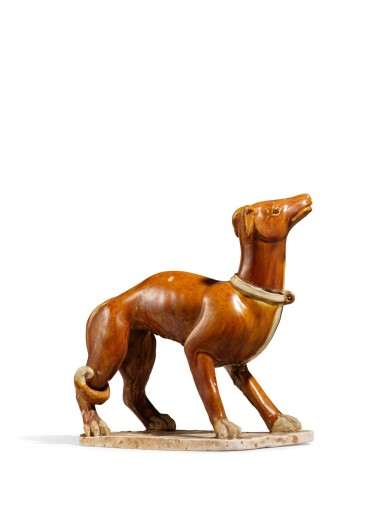
A rare amber-glazed figure of a dog, Tang dynasty | 唐 褐釉犬
Session begins in
September 4, 02:00 AM GMT
Estimate
150,000 - 300,000 HKD
Lot Details
Description
double Japanese wood box
h. 25.4 cm
Collection of Marquis Hosokawa Moritatsu (1883–1970), Tokyo, by 1928.
Kochukyo Co., Ltd, Tokyo.
Uragami Sokyu-do Co., Ltd, Tokyo.
Tokubetsu Ten Chugoku no Toji / Special Exhibition: Chinese Ceramics, Tokyo National Museum, Tokyo, 1994, cat. no. 123.
Special Triennial Tobi Art Fair, Tokyo Bijutsu Club, Tokyo, 2001, pp. 55–56.
Nakao Manzo, Tosansai zufu [Illustrated Catalogue of Tang Sancai Ware], Tokyo, 1928, p. 44.
Geijutsu Shincho, vol. 1, issue 12, December 1950, p. 141.
The 30th Anniversary of Uragami Sokyu-do, Uragami Sokyu-do Co., Ltd, Tokyo, 2009, p. 134.
Uragami Mitsuru, Kobijutsusho ni manabu Chugoku Chosentoji no Mikata Erabikata [A Dealer's Eyes: Appreciating and Collecting Chinese and Korean Ceramics], Kyoto, 2011, p. 42.
來源
細川護立侯爵(1883至1970年)收藏,東京,1928年或之前
壺中居,東京
浦上蒼穹堂,東京
展覽
《特別展—中国の陶磁》,東京國立博物館,東京,1994年,編號123
《第15回東美特別展》,東京美術俱樂部,東京,2001年,頁55至56
出版
中尾萬三,《唐三彩圖譜》,東京,1928年,頁44
《藝術新潮》,1卷12號,1950年12月,頁141
《浦上蒼穹堂30周年記念》,浦上蒼穹堂,東京,2009年,頁134
浦上満,《古美術商にまなぶ中国.朝鮮古陶磁の見かた、選びかた》,京都,2011年,頁42
Dogs have accompanied humans for millennia, and in China their importance is evident in burial practices as early as the Shang dynasty (c. 1600–1046 BC), when they were interred alongside the dead. This close association continued into later periods, and by the Tang dynasty (618–907) was expressed through ceramic tomb figures, with animals forming a lively part of the funerary assemblage. Yet within these groups, horses and camels predominate, reflecting the cosmopolitan culture of the Silk Road, while representations of dogs remain comparatively rare among surviving examples.
The type of dog represented here is generally associated with Central Asian sighthounds, particularly the Saluki: slender, long-limbed hunting dogs prized for their speed and keen sight, and still survive in parts of the region today. They bear a visual resemblance to greyhounds, but can be distinguished by their long, pendulous ears, in contrast to the shorter, pricked ears of the latter. Dogs of this type also appear in Tang paintings, including works such as Admonitions in Chains, traditionally attributed to Yan Liben (c. 600–674), now in the Freer Gallery of Art (acc. no. F1911.235).
Very few comparable examples have survived, and most are now held in major museum collections. See an amber-glazed figure in the Tokyo National Museum (acc. no. TG-1919) and a similarly sized white-and-green-glazed example in the Metropolitan Museum of Art (acc. no. 29.18). Both appear more rigid and frontal in conception. By contrast, the present figure displays a greater sense of movement and animation, placing it among the more accomplished surviving works of its kind.
犬類伴隨人類數千載,其於中華文明中之重要性,早見於商代之喪葬習俗,常作陪葬之用。此般密切關係延續至後世,及至唐代,則見於陶瓷製作中,動物陶俑遂成隨葬品中生動之一環。然此類陶俑多以馬及駱駝為主,反映絲綢之路之多元文化,相比之下,犬類陶俑於傳世品中則較為罕見。
本品所塑之犬種,普遍認為與中亞視覺型狩獵犬有關,尤指薩路基獵犬。此類獵犬身形修長、四肢纖細,以速度及敏銳視覺見稱,至今仍見於該地區。其外貌雖與靈緹犬相似,然前者雙耳長而下垂,後者雙耳短而直立,兩者可藉此區分。此類犬隻亦見於唐代繪畫,如傳為閻立本(約600–674年)所作之《鎖諫圖》,現藏華盛頓弗利爾美術館(館藏編號:F1911.235)。
傳世之同類作例寥寥可數,且多藏於大型博物館。參考東京國立博物館藏一褐釉例(館藏編號:TG-1919),以及紐約大都會藝術博物館藏一尺寸相若之白地綠釉例(館藏編號:29.18)。然該兩例之姿態較為僵硬且偏向正面。相比之下,本品動態更為生動傳神,實屬同類傳世器中之佳作。
You May Also Like


