
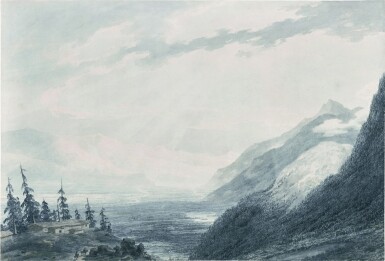
Drawn to Life – Works on Paper from a Distinguished Private Collection
John Robert Cozens
The Approach to Martigny, Rhone Valley, Valais
Estimate
80,000 - 120,000 USD
Lot Details
Description
Drawn to Life – Works on Paper from a Distinguished Private Collection
John Roberts Cozens
(London 1752 - 1797)
The Approach to Martigny, Rhone Valley, Valais
Watercolor over traces of pencil on laid paper watermarked with the Fleur-de-lis and IHS / IVIILEDARY(?)
428 by 625 mm; 17 by 24¼ in.
Victor George Robert Rienaecher (1887-1972), by 1934;
James Leslie Wright (1862-1954), by 1946,
Colonel Percy Leslie Malins Wright (1898-1976),
by descent to his wife, Susan, later Lady Dunphie (1909-2011),
with Andrew Clayton-Payne, London,
by whom sold to the present owner.
London, The Arts Council of Great Britain, The English Romantics, 1946, no. 2;
London, Royal Academy, Exhibition of The J. Leslie Wright Collection of Masters of British Water-Colour, 1949, no. 114
C.F. Bell & T. Girtin, ‘The Drawings and Sketches of John Robert Cozens’, Walpole Society, vol. XXII, London 1934-5, p. 29, no. 12 vi;
C.F. Bell & T. Girtin, ‘The Sketches and Drawings of John Robert Cozens, some additions and notes to the twenty-third volume of the Walpole Society’, London 1941, p. 5, under no. 12;
A. Wilton, The Art of Alexander and John Robert Cozens, exhibition catalogue, Yale Center for British Art, New Haven 1980, p. 50, under no. 135;
F. Hawcroft, Watercolours by John Robert Cozens, exhibition catalogue, Whitworth Art Gallery, Manchester and the Victoria and Albert Museum, London, 1971, p. 13, under no. 2
This exquisite watercolor, one of the most beautiful of all Cozens’s works to remain in private hands, has not been seen in public since it was exhibited at the Royal Academy in 1949, alongside other masterpieces from the celebrated collection of James Leslie Wright (1862-1954). Its reemergence now is cause for considerable excitement, all the more so because of its superb state of preservation.
Cozens presents a stunning alpine landscape, the drama of which is only increased by his bold choice of composition. From on high, as if suspended between the land and sky, he looks south, down, onto the vast expanse of the Rhone Valley with its farms, church steeples and the silvery river Rhone itself, whose serpentine form gently draws the eye back into the far distance. In the foreground two figures on horseback make their way slowly past a cluster of farm buildings, their size only serving to emphasize the massive scale of the terrain they find themselves travelling through.
Cozens’s treatment of light is here both ground-breaking and extraordinary. Whereas the foreground, with its great banks of fir trees blanketing the steep mountainside to the right and dramatically silhouetted firs standing, precariously, on the ridge to the left, is captured with great clarity, the scene beyond is defined by a misty, diffused, even sublime light, which dissolves geographical form and moves the watercolor firmly outside the realm of the topographical. Increasing the sense of poetic beauty are the subtle rays of light that stream down like fingers from the heavens above. Here, Cozens can be seen exploring how to capture the spirit of a place, an idea that had been introduced by his father, Alexander Cozens (1717-1786), and that was to have a far-reaching influence on future generations of British artists.
Cozens passed through this spectacular place on 30 August 1776, while on his Grand Tour with the connoisseur Richard Payne Knight (1751-1824).1 The pair had left London earlier that summer and having travelled along the north side of Lake Geneva, they reached the Rhone Valley at the end of August. Ultimately, they were on their way to Rome, where Cozens would stay until 1779 before returning to England.
The present watercolor, which is likely to date from the 1780s, relates to two sketches by Cozens; an on-the-spot pencil drawing (now in the Sir John Soane Museum) that is inscribed: Approach to Martinach Pais de Vallais August 30-1776 [sic, sic], and a monochrome wash drawing in the Leeds City Art Gallery, that Cozens has inscribed: Pais de Vallais, nearthe Lake of Geneva.2
The Soane drawing is particularly interesting as it also includes a list, written by the artist, of eight names:
Sir R.[ichard Colt] Hoare, Mr Wigstead, Mr Chalie, Mr Walwine, Mr Windham, Mr Sunderland, Dr Chelsum and Sir Frederick Eden. These appear to have been patrons who had, or who Cozens hoped would, commission large-scale watercolors of this subject.3 Indeed this view did prove popular and Cozens may have painted as many as eight large watercolors of it over a number of years. While the fate of two such works that appeared at auction at Greenwood’s of London in 1786 and 1789 is unknown, six watercolors survive today.4 Two, including the present lot, are in private collections, while the four others are held in public institutions, namely in the City of Birmingham Art Gallery (a work dated 1780), the National Trust at Stourhead, Wiltshire (the watercolor that Sir Richard Colt Hoare acquired in 1788), the Fitzwilliam Museum, Cambridge and the Yale Centre for British art, New Haven (two works that may date to circa 1790).5
This watercolor has a notable provenance, having belonged to the London architect Victor George Robert Rienaecker, before entering the Wright and then Dunphie collections. James Leslie Wright of Haseley House, Warwick, began collecting in the late 1920s and over the next thirty years put together a superb collection of watercolors and drawings that focused on the early British school. In 1953 he bequeathed over 400 works to the Birmingham Museum and Art Gallery. His son Percy, who inherited the present lot, was a member of Lloyds and a distinguished officer in the British army. After his death in 1976, the work stayed with his wife, Susan, née Arkwright, who married Major-General Sir Charles Anderson Lane Dunphie (1902-1999) in 1981.
We are very grateful to Timothy Wilcox and Neil Jeffares for their help when cataloging this work.
1.Cozens travelled for a second and final time on the Continent in 1782-3, this time in the company of William Beckford
2.Leeds City Art Gallery, acc. no. 13.88/53 & Sir John Soane Museum, acc. no. 44/12/15
3.From this list, only two are known certainly to have acquired this subject from Cozens: Sir Richard Colt Hoare of Stourhead and Sir Frederick Eden (see C.F. Bell & T. Girtin, op. cit., 1934-5, no. 12 II & III)
4.London, Greenwood’s, 7 April 1786, lot 40, (as The valey [sic] of Sion, Switzerland, by Cozens) and London, Greenwood’s 19 March 1789, lot 49 (as A ditto of the Vallias near Martigne [sic, sic])
5.C.F. Bell & T. Girtin, op. cit., 1934-5, no, 12 II-VI & Yale Center for British Art, New Haven, acc. no. B1975.4.1902
You May Also Like


