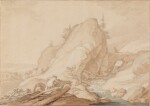
Florentine School, first half of the 16th Century
A study after Michelangelo's Aurora in the Medici Chapel
Live auction begins on:
July 1, 09:30 AM GMT
Estimate
8,000 - 12,000 GBP
Lot Details
Description
Florentine School, first half of the 16th Century
A study after Michelangelo's Aurora in the Medici Chapel
Black chalk
197 by 296 mm
Samuel Woodburn (1786-1853), London, his mount (trimmed), from a pencil inscription on a old mount: Sketch from the figure of "The Dawn"/ for the Tomb of 'Lorenzo di Medici' Florence / Michel Angelo / (from Woodburn Collection)
Sale, New York, Christie's, 30 January 1997, lot 16,
where acquired
An interesting copy, most certainly by a Florentine master, from Michelangelo's sculpted figure of Aurora ('Dawn') in the Medici chapel, in the New Sacristy of San Lorenzo, Florence.
Because of the angle at which the figure is drawn, seen from above and from one side, it can be argued that this drawing was executed in front of the original, before its installation on the Medici tomb in 1545. In fact, in the drawn copy the sculpture is not shown at the descending angle at which it was actually placed, fairly high up on the tomb below Duke Lorenzo de' Medici, but is seen tilted back and seen from above. The figure appears gently reclining, resting on her right arm, and it is probable that the draftsman saw the sculpture while it was still on the floor of the chapel.
A number of copies from the Aurora are known, and in the past the present sheet has been associated with another study, also executed in black chalk, at Chatsworth. The Chatsworth drawing, which copies the sculpture from above and is similarly truncated at the level of the knees, was attributed to Salviati by Michael Jaffé,1 but has subsequently – and rightly – been given to Naldini by Alessandro Cecchi.2 Stylistically, the present sheet cannot, however, be associated with Naldini.
A full-length, red chalk copy by Salviati of the sculpted figure is preserved in the collection of the British Museum, and another by the same master in black chalk, in this case seen from a similar viewpoint to the present study and likewise truncated at the level of the knee, is in the National Gallery of Scotland.3
As was suggested prior to the 1997 sale (see Provenance), the present drawing, with its delicate execution and finesse in the use of the black chalk, appears close to the work of artists in the orbit of Bronzino.
The watermark at the bottom edge (partly cut) is an early watermark found on paper used by Michelangelo in around 1525: Star, C: Star in a large circle; see J. Roberts, A Dictionary of Michelangerlo's watermarks, Milan 1988, p. 25
1.M. Jaffé, The Devonshire Collection of Italian Drawings, Tuscan and Umbrian Schools, London 1994, no. 62
2.A. Cecchi, Francesco Morandini detto Il Poppi, Florence 1995, under D.17, pp. 215-6
3.London, British Museum, 1900,0824.118; J. Wilde, Italian Drawings in the Department of Prints and Drawings in the British Museum, Michelangelo and his Studio, London 1953, no. 102, reproduced; Edinburgh, National Gallery of Scotland, RSA 863; the traditional attribution to Salviati was confirmed by Jean-Luc Baroni in 1988. As Raphael Rosenberg was the first to point out (letter of 1993 in the Gallery files), the drawing was used as the model for an etching, in reverse, by Jan de Bisschop, published as plate 23 of his Paradigmata Graphius varium Artificium (The Hague, 1671).
You May Also Like