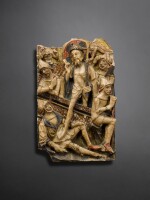
Circle of Giovan Angelo del Maino
Pieta
Live auction begins on:
July 1, 01:00 PM GMT
Estimate
15,000 - 20,000 GBP
Lot Details
Description
Circle of Giovan Angelo del Maino
active Pavia and Milan 1496–1536
Pieta
polychromed wood
49 by 41.5 by 8cm., 19¼ by 16⅜ by 3⅛in.
This powerful Pietà group is imbued with the spirit of the Lombard Renaissance. Its traditional composition is handled with dynamism with the Virgin rushing forward to support her Son. The intense emotion of St John’s agonised expression contrasts with Christ’s calm serenity. The energy of Mary’s embrace, the passion of her focus and the form of her wimple and cloak recall the figure of the Virgin in the late 15th century marble Lamentation attributed to the Milanese Mantegazza brothers, Antonio and Cristoforo, in the Victoria and Albert Museum (inv. no. 8-1869).
Another very close comparison from Lombardy can be observed in a painted lunette (inv. no. 5546, oil on panel, 80 by 145cm.) in the Pinacoteca di Brera attributed to the Milanese artist, Ambrogio da Fossano, called Il Bergognone. The compositions are virtually identical, both with the unusual feature of St John weeping into a handkerchief and the composition of Christ with folded arms. Even allowing for the difference in scale and material it is clear that these works originate from the same artistic and cultural milieu.
Bergognone was active in Milan from the last quarter of the 15th century. Some of his earliest works are in the Certosa di Pavia, where he became the chief painter from the late 1480s. His works from this period reflect the influence of Vincenzo Foppa. He developed a style known as maniera grigia because of the overall silvery tone that he used in his works until around the early 16th century.
There is a rich tradition of polychrome wood sculpture in Lombardy and it has been proposed that the present Pietà comes from the circle of the Giovan Angelo Del Maino, active in Milan around 1500. Prof. Raffaele Casciaro’s 2018 article on the Del Maino family examined the emergence of Giovan Angelo’s style from that of his father Giacomo’s, with whom he trained. The present Pietà can be compared to the relief of the same subject illustrated by Casciaro (op. cit., fig. 14), the style of which he distinguishes from the work of Giacomo as ‘more naturalistic and the carving more subtle and sinewy. The more elongated anatomies of the figures, the intense pathos, and the meticulously rendered, wavy hair are clearly reminiscent of Giovan Angelo’ (Casciaro, op. cit., p. 27), comments equally applicable to the present work.
A label on the reverse of this panel indicates that it was once with the legendary Turinese art dealer Pietro Accorsi (1891-1982) who became famous when he acquired the Trivulzio Belgioioso collection in 1935. Accorsi's career flourished with the post-war industrial revival in northern Italy and his clients included the leading industrialists and collectors of his day, such Giovanni Agnelli and Werner Abegg. The Pietro Accorsi Foundation was established in 1983 and the Museum of Decorative Arts housing his collection opened in the Palazzo Accorsi in 1999.
RELATED LITERATURE
R. Casciaro, ‘Giovan Angelo del Maino I - La formazione e gli anni giovanili’, in Nuovi Studi Rivista di Arte Antica e Moderna’, 1996, anno I, pp. 47-64; R. Casciaro, ‘Tra Giacomo e Giovan Angelo Del Maino, sullo scorcio del Quattrocento’, in Il Capitale culturale: Studies on the Value of Cultural Heritage, no. 18, 2018, pp. 13-42;
You May Also Like