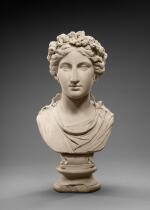
British, 18th century
Pair of Busts of Laughing and Sulking Children
Live auction begins on:
July 1, 01:00 PM GMT
Estimate
10,000 - 12,000 GBP
Lot Details
Description
British, 18th century
Pair of Busts of Laughing and Sulking Children
marble
34cm., 13⅜in.
The attribution of these heads of laughing and crying children has long been a topic of debate. Several sources for the depiction of such contrasting emotions have been discussed, from Michelangelo’s plans for the angels on the tomb of Julius II to Bernini’s angels in his groups of St Teresa and Habakkuk to the work of Balthasar Permoser (Penny, op. cit., pp. 17-18). The iconographic conceit of children as infant representations of the Greek philosophers Heraclitus (laughing) and Democritus (crying) was already used by the French sculptor Thomas Regnaudin, who exhibited these subjects at the Salon in 1673; a theme also taken up by François Girardon. Jean-Antoine Houdon’s heads known as Pleur et Rire demonstrate the continuing Continental appeal of this theme into the 18th century (ibid. p. 18). The theme also became particularly popular
in England.
Since the publication of the unique Chelsea porcelain Head of a laughing child in the Ashmolean Museum (ibid. cat. no. 457) by Bellamy Gardner in 1938, the present model of the Laughing Child has been associated with Louis-François Roubiliac, and by association its pendant in other various materials. This proposition is supported by six records of ‘laughing boy’ and one ‘crying boy’ listed in a sale of Roubiliac’s works in 1762. However, whilst Penny considers that the attribution to Roubiliac ‘is not impossible’, the fact is ‘there is no proof of Roubiliac working for the Chelsea factory and no close relationship between this [Chelsea porcelain] head and any of his sculptures’ (ibid., p. 17). Despite this ‘circumstantial evidence’, Baker also considers the attribution to Roubiliac ‘highly speculative’ (Baker, op. cit., p. 91). Evidence that the subject of a laughing child was linked with other 18th-century English sculptors is provided by the record of one by John Flaxman in 1771 (ibid., p.175) and the signed marble by Joseph Nollekens in the Hermitage Museum, St. Petersburg (inv. no. H.ck-296). A very similar pair of busts, also in marble, are in the collection at the National Gallery of Melbourne, both catalogued as Italian, 18th century (inv. no. 1505A.a-b-D4 and 1505B.a-b-D4).
RELATED LITERATURE
B. Gardner in Connoisseur, August 1938, pp. 59-60; N. Penny, Catalogue of European Sculpture in the Ashmolean Museum 1540 to the Present Day. III, Oxford, 1992, pp. 17-19, no. 457; M. Baker, Figured in Marble. The Making and Viewing of Eighteenth-century Sculpture, London, 2000, pp. 91-92, 174-175 n. 35.
You May Also Like