
Property from an English Private Collection
Hiram Powers
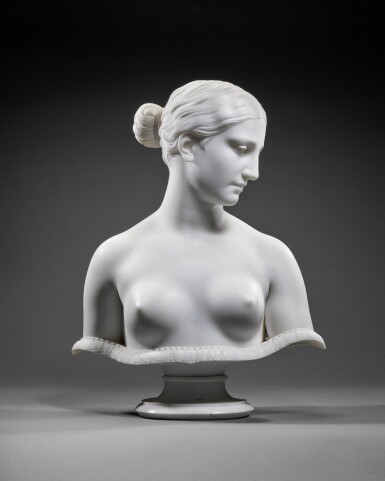
Bust of a Greek Slave
Live auction begins on:
July 1, 01:00 PM GMT
Estimate
40,000 - 60,000 GBP
Lot Details
Description
Property from an English Private Collection
Hiram Powers
Woodstock 1805 - 1873 Florence
Bust of a Greek Slave
signed: H. POWERS / Sculp.
marble
62cm., 24½in. overall
‘The celebrated Greek Slave ... is surely one of the most exquisite embodiments of grace, beauty and symmetry that the hand of man ever executed, or even his heart conceived. Let the canting of prurient objectors to the nude gaze on this, with its irresistible grace and pathos, and utter absence of the sensual, and go away rebuked and purified, to return, as all do return, to gaze on that most sweet and saddening sight' (Edinburgh Political and Literary Journal, 10 May 1851).
No other single piece of 19th-century sculpture was more praised, eulogised or parodied than Powers's Greek Slave. The circumstances of its fame were without precedent. Never before had a marble statue embarked on an equivalent world tour, being shown to huge crowds in Europe and across the United States. Its appearance at the Great Exhibition in London in 1851, organised without the sculptor's knowledge, was an unqualified success, with crowds said to have admired her nude beauty in silent awe.
Once the Greek Slave embarked on its public round of exhibitions, Powers was careful to ensure that its subject was clearly understood. The theme is taken from the Greek revolution of the 1820's. The young woman has been abducted by the Turks and is about to be sold in a slave market. Powers explained in his own words that, 'she stands exposed to the people she abhors, and waits her fate with the intense anxiety, tempered indeed by the support of her reliance upon the goodness of God. Gather all the afflictions together and add to them the fortitude and resignation of a Christian, and no room will be left for shame. Such are the circumstances under which the Greek Slave is supposed to stand.'
The Greek Slave is today regarded as Powers's most iconic sculpture. As Lauretta Dimmick writes in the Metropolitan Museum of Art catalogue of American sculpture, it 'became the most famous sculpture of the period and established Powers's international reputation' (Tolles, op. cit., p. 8). Wunder records that only nine full size versions were carved, the first being the superb marble at Raby Castle in County Durham. Powers offered busts of the Greek Slave in either life-size or two-thirds life-size versions.
The present bust is typical of the busts Powers carved, in bearing the signature: H. POWERS / Sculp., and in being truncated just below the breasts.
RELATED LITERATURE
R. P. Wunder, Hiram Powers: Vermont Sculptor, 1805- 1873, Newark, 1991, vol. I, pp. 207-274, vol. II, pp. 157- 177; T. Tolles (ed.), American Sculpture in the Metropolitan Museum of Art, New York, 1999, vol. I, pp. 8-9; F. Falletti, S. Bietoletti and A. Caputo (eds.), Lorenzo Bartolini. Beauty and Truth in Marble, exh. cat. Accademia, Florence, 2011, pp. 330-331, no. 60
You May Also Like


