
Property from the Collection of Dr. Hinrich Bischoff
Gillis Mostaert the Elder
Christ on the Road to Calvary
Live auction begins on:
February 6, 03:00 PM GMT
Estimate
100,000 - 150,000 USD
Bid
70,000 USD
Lot Details
Description
Property from the Collection of Dr. Hinrich Bischoff
Gillis Mostaert the Elder
Hulst circa 1528/1529 - 1598 Antwerp
Christ on the Road to Calvary
oil on oak panel, in a painted frame
panel: 22 ⅝ by 29 ⅞ in.; 57.4 by 76.0 cm
framed: 32 by 39 in.; 81.2 by 99.1 cm
With Kunsthandel Nystad, The Hague, by 1957;
With Martin Asscher, London, by 1958;
Private collection, Monaco, by 1968;
With Artemis Group, London, by 1983;
With Galerie Noortman, London and Maastricht;
Dr. Hinrich Bischoff (1936-2005), by 1987;
Thence by inheritance.
Cologne, Wallraf-Richartz-Museum, long-term loan, 1987-2025 (inv. no. Dep. 546).
C. van de Velde, “Taferelen met grisaillelijsten van Gillis Mostaert," in Essays in Northern European Art Presented to Egbert Haverkamp-Begemann on his Sixtieth Birthday, Groningen 1983, pp. 277-278, 281-282, reproduced fig. 1;
E. Mai, "Erwerbungen," in Wallraf-Richartz-Jahrbuch: Westdeutsches Jahrbuch für Kunstgeschichte 48-49 (1987-1988), pp. 533-534, reproduced fig. 1;
E. Mai, in Das Kabinett des Sammlers: Gemälde vom XV. Bis XVIII. Jahrhundert, E. Mai (ed.), Cologne 1993, pp. 50-52, cat. no. 20, reproduced;
E. Mai, "Historie und Landschaft - Aspekte der Gattung bei Gillis Mostaert," in Die Malerei Antwerpens - Gattungen, Meister, Wirkungen: Studien zur flämischen Kunst des 16. und 17. Jahrhunderts, E. Mai, K. Schütz, and H. Vlieghe (eds.), Cologne 1994, pp. 31, 34 note 26;
E. Mai, in Gillis Mostaert (1528-1598): Ein Antwerpener Maler zur Zeit der Bruegel-Dynastie, E. Mai (ed.), Wolfratshausen 2005, p. 32, reproduced fig. 18;
L. Hendrikman and D. Tamis, Brueghel and contemporaries: Art as covert resistance?, exhibition catalogue, Maastricht 2021, p. 196, under cat. no. 65, reproduced (the painted frame attributed to Mostaert's studio).
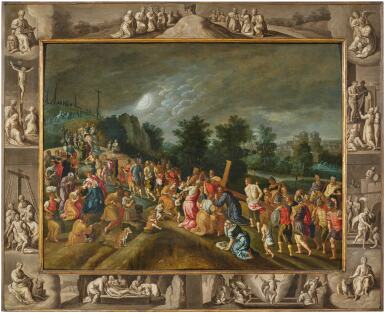
Datable to 1575-1589, this intriguing painting belongs to a small group of works by Gillis Mostaert that comprise a central panel rendered in color and a frame painted en grisaille. Such grisaille frames are usually divided into sections, each of which depicts an episode that relates to the principal scene on the central panel.1 In this instance, the central panel portrays Christ on the Road to Calvary and the images on the frame represent the four Evangelists and scenes from the Passion.
Few other works with grisaille frames by Mostaert have survived, save for the Christ on the Cross in the Museum für Kunst und Kulturgeschichte der Stadt Dortmund, Schloss Cappenberg, Selm,2 and the Baptism of Christ at the Fondation Custodia, Paris, which is monogrammed and dated 1598.3 The Selm picture, the Paris painting, and the present work have all been associated previously with Frans Francken the Younger,4 who, with the help of his workshop,5 likewise produced pictures with grisaille painted frames. However, Francken's grisaille "frames" were almost always painted on the same piece of panel as his central compositions, in trompe-l'œil,6 while Mostaert's panels and grisaille frames were constructed separately, as in the present example.7 As such, this painting has been published as Mostaert since 1983.
The composition is arranged along a sweeping diagonal axis, which draws the viewer's eye from the bottom right corner, in which Christ carries the Cross, to Calvary at top left. The scene is populated by a vast number of figures, who convey a diverse range of emotional reactions: a group of lamenting women and children stand beside Christ, while gangs of thieves and soldiers march both ahead of and behind him. Saint Veronica kneels in the foreground, weeping over the Sudarium. A crowd has gathered at bottom left, among them Mary in a blue robe, who, on the verge of collapse, is being comforted by Saints John the Evangelist and Anne. Despite their small scale, the figures exhibit remarkably three-dimensional modeling and the muscular bodies seen from behind evidence Mostaert's study of Italian painting.8 Michelangelo, in particular, influenced Mostaert's work; his motifs must have reached Antwerp by way of Frans Floris, Hieronymus Cock, and Pieter Bruegel the Elder, all of whom travelled to Rome.9
The popularity of the central panel's composition among Mostaert's patrons is attested to by the existence of at least two other versions: the picture sold at Sotheby's London in 2013,10 which was previously in the Schaumburg-Lippe Collection, and an inferior treatment of the subject by Mostaert's workshop that was offered at Sotheby's London in 2022.11
1 Van de Velde 1983, p. 281.
2 Van de Velde 1983, p. 282, reproduced fig. 3.
3 Inv. no. 6690; oil on panel, panel: 20 ¼ by 26 in.; framed: 30 ½ by 36 ¼ in. Van de Velde 1983, p. 282, reproduced fig. 4.
4 Van de Velde 1983, p. 281.
5 Studio assistants would have likely been involved in the production of Mostaert's grisaille frames too. Lars Hendrikman and Dorien Tamis attribute the execution of the present painting's frame to Mostaert's workshop. Hendrikman and Tamis 2021, p. 196.
6 Francken's picture in the Leuven Museum constitutes an exception: the grisaille frame is separate from the central panel. Inv. no. S/21/F; oil on panel, 28 ¾ by 40 ½ in.
7 Hendrikman and Tamis 2021, p. 195.
8 Mai 1993, p. 52; Mai 1994, p. 31.
9 Mai 1993, p. 50.
10 Oil on oak panel, 22 ⅛ by 29 ¼ in. London, Sotheby's, 4 December 2013, lot 30.
11 Oil on oak panel, 22 by 29 ⅛ in. London, Sotheby's, 1-7 July 2002, lot 107.
You May Also Like


