
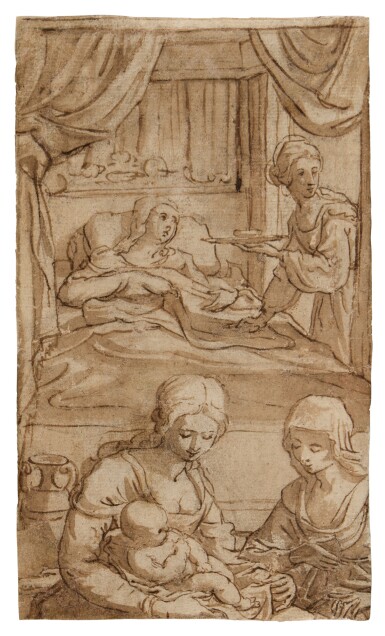
Romulo Cincinato
The Birth of the Virgin
Estimate
4,000 - 6,000 USD
Lot Details
Description
Romulo Cincinato
(Florence 1540 - 1597 Madrid)
The Birth of the Virgin
Pen and brown ink and wash over black chalk
188 by 110 mm; 7½ by 4⅜ in.
Artur Ramon Art, Barcelona;
Elrick-Manley Fine Art Inc., New York,
where acquired by Diane A. Nixon
The attribution of the present drawing to this rare artist, a native of Florence who was mainly active in Spain, is due to Mary Newcome and Manuela Mena.
Little is known about Cincinato's early training, but he is believed to have been a pupil of Francesco Salviati (1510-1563). Both the traditional composition and the style of the present drawing show debts to the Florentine artistic milieu. This complete drawing, executed in pen and ink and wash, within brown ink framing lines, must have served as a preparatory study for a fresco, probably as part of a decorative scheme representing the life of the Virgin. In 1567, Cincinato signed a contract to work with the Arezzo-born artist Patrizio Cascese (1544-1612) in Madrid, under the supervision of Gaspar Becerra (1520-1568). Cincinato worked in the Alcázar in Madrid, and in the Pardo palace, until 1571, and thereafter was mainly involved with the decoration of the Escorial until his death.
Drawings played an important part in the major decorative schemes of the Escorial, and the many Italian artists who contributed to these projects in the second half of the sixteenth century had a lasting influence on the artistic development of subsequent generations in Spain. Among the first artists to arrive in Spain from Italy were Francesco da Urbino (c.1545-1582) and Giovanni Battista Castello (c.1509-1569), who were also involved in the decoration of the Alcázar in Madrid. As Mark McDonald has noted, Philip II - who had appointed Castello as court architect and painter in charge of a large workshop, supervising all the projects for the monastery of the Escorial and the other royal residences - insisted from the outset on drawn designs for the Escorial, because they allowed him to oversee its construction, control expenses and ensure that no changes were made after he had given his approval.1
1.M.P. McDonald, Renaissance to Goya. Prints and Drawings from Spain, exhib. cat., London, British Museum, 2012, p. 58, and note 13
You May Also Like


