Pablo Picasso
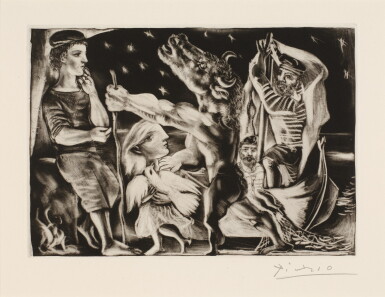
Minotaure aveugle guidé par une fillette dans la nuit, from the Vollard suite (Bloch 225; Baer 437)
Estimate
100,000 - 150,000 USD
Lot Details
Description
Pablo Picasso
Málaga 1881 - 1973 Mougins
Minotaure aveugle guidé par une fillette dans la nuit, from the Vollard suite (Bloch 225; Baer 437)
signed in pencil (lower right)
etching and drypoint with aquatint on Montval laid paper
plate: 9 ⅝ by 13 ⅝ in.; 24.5 by 34.7 cm
sheet: 15 by 19 ⅞ in.; 38.2 by 50.5 cm
Executed in 1933; this impression is from the edition of 50 on large format paper (the total edition is 310), published by Vollard.
Henri M. Petiet (1894-1980), Paris;
Private Collection, Paris (acquired by descent from the above);
With C.G. Boerner, New York;
From whom acquired by the present collector, 30 September 2014.
G. Bloch, Pablo Picasso, catalogue de l’œuvre gravé et lithographié, 1904-1967, vol. I, Bern 1968, cat. no. 225, pp. 72-73 , another impression illustrated;
B. Baer, Picasso peintre-graveur, vol. II, Bern 1992, cat. no. 437, p. 314, another impression illustrated.
The Vollard Suite is Picasso’s most important series of etchings. Created in bouts of fervent activity between 1930 and 1937, the series was retrospectively named for Ambroise Vollard, the great Parisian print publisher and art dealer behind its creation. The wide-ranging source imagery is partially autobiographical—perhaps most apparent across the fifteen prints detailing the narrative arc of the Minotaur, the half-man, half-beast figure with whom Picasso related deeply. The art critic Robert Hughes wrote that Picasso “was the Minotaur in a canvas-and-paper labyrinth of his own construction,” and indeed to the artist, the Minotaur represented the turmoil of his own uncontrollable desires (Robert Hughes, “The Artist Pablo Picasso”, Time, 1998). That turmoil is most directly observed in the depictions of Picasso, often as the Minotaur, with Marie-Thérèse Walter, the artist's young lover, nearly thirty years his junior.
Marie-Thérèse’s presence in the suite ranges from serving as a sculptor's model to dreaming of Ovid’s Metamorphoses. In the present image, one of the strongest and most compositionally complex in the series, she is guiding the blind and helpless Minotaur through the night. The Minotaur, who has already undergone a transformation from young and inquisitive faun to fully-fledged and wildly savage beast, has been blinded and enfeebled. The young Marie-Thérèse holds a white dove while their journey is watched by three fishermen, witnesses from the ordinary world to a bizarre mythological drama. Picasso employs every resource at his disposal: the distorted surrealist setting, the Grecian profile of Marie-Thérèse that hints at cubist depictions, and his mastery and combination of the intaglio mediums in a single image.
Minotaure aveugle guidé par Marie-Thérèse au pigeon dans une nuit étoilée is representative of Picasso's dominance of the 20th century. His fame extended past the worlds of art, politics and culture—Hughes writes that “more people have heard of him than ever heard the names, let alone saw the work, of Michelangelo, Rembrandt or Cézanne while they were alive” (Robert Hughes, “Anatomy of a Minotaur”, Time, 1998). That level of recognition befits an artist consumed as equally by genius as he was by his lust for creation. To make art was, for Picasso, to live. Much like the Minotaur, that creative lust was inherent and uncontrollable: the anguish across the face of the Minotaur in the subject work carries within it the feverish emotion and mastery of the medium that willed Pablo Picasso to his status as an icon of modern art.
You May Also Like