
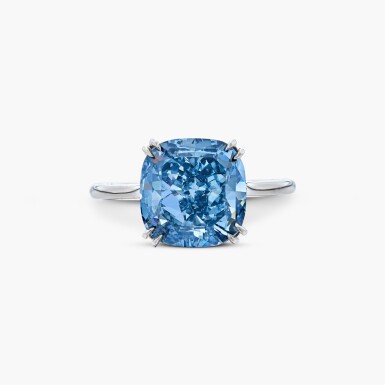
An Exceptional and Rare Fancy Vivid Blue Diamond Ring 非凡罕見 6.03克拉 艷彩藍色 内部無瑕 鑽石 戒指
Live auction begins on:
May 12, 12:00 PM GMT
Estimate
7,200,000 - 9,600,000 CHF
Bid
5,000,000 CHF
Lot Details
Description
Featuring a cushion-shaped fancy vivid blue diamond weighing 6.03 carats, size 53.
Accompanied by GIA report no. 2231458438, dated 10 February 2025, stating that the diamond is Fancy Vivid Blue, Natural Colour, Internally Flawless; together with a type IIb classification letter, as well as a letter attesting to the rarity of the stone and that it originated from the Cullinan mine in South Africa. Further accompanied by a GIA Monograph.
Fancy Vivid Blue Diamonds
Only 0.3% of all diamonds display a colour that is predominantly blue. Of this only a very small subsection qualifies as Fancy Vivid Blue. In a study comprising over 462 blue diamonds, the Gemmological Institute of America (GIA) graded merely 1% as Fancy Vivid Blue. Research conducted by the GIA established that blue diamonds are formed far deeper in the Earth’s mantle than any other diamonds. Furthermore, the world-renowned laboratory also discovered an inherent link between blue diamonds and the oceanic waters.
Grading Blue Diamonds
Blue diamonds occur in a wide range of tones, but only in a relatively small range of saturation. As the grade boundaries are more nuanced than is the case for other coloured diamonds, longstanding experience is required to face the challenges of grading blue diamonds. The differences in tone can easily be misinterpreted as differences in saturation to the inexperienced eye.
Sources
From the 1860s onwards, South Africa emerged as the predominant source, not just of large and beautiful colourless diamonds, but occasionally of rare fancy coloured diamonds as well. South African mines that are known to have produced blue diamonds include Jagersfontein and Koffiefontein, both of which were located near Kimberley. Smaller sources were also found at the Bellsbank mine near Barkly West and at the Helam mine in Swartsruggens. Very rarely, blue diamonds have been found in alluvial deposits at Lichtenburg in the Western Transvaal. Historically, central Africa has been a source, particularly the Congo and Angola. Other West African countries such as Guinea and Sierra Leone are also known to have produced blue diamonds. Outside of Africa, blue diamonds have also been discovered in Borneo.
Type IIb Diamonds
The type IIb classification signifies that a small amount of the trace element boron is present in a diamond’s chemical composition. Boron in turn contributes strongly to the blue appearance of the diamond, which is also related to exposure to high pressure during the formation process. An unusual property of type IIb diamonds is their high electric conductivity.
Boron and Oceanic Crustal Subduction
Boron is a chemical element that is concentrated in rocks and sediments near the Earth’s surface. When these crustal rocks weather and decompose, boron is filtered into rivers where it is delivered as dissolved chemical elements into the ocean. In mantle rocks, however, the concentration of boron is very low.
Recent scientific studies suggest that boron, incorporated in clays and other minerals in the oceanic crust, is carried down into the mantle along with hydrous minerals by a conveyor-like-process which is called oceanic crustal subduction by geologists. In the mantle, these crustal minerals break down and release a boron-rich fluid that triggers diamond formation.
Formation
It is possible for geologists to age-date the formation of rough diamond crystals based on tiny amounts of radioactive mineral inclusions which get trapped in the growing crystals. It is now known that diamond formation began as much as 3.5 billion years ago, and the resulting crystals then remained deep in the earth for millions of years, before being emplaced near the earth’s surface in more recent geological times.
Most blue diamonds contain boron and little to no nitrogen, they display an irregular crystal lattice and can sometimes occur in large sizes. These features suggest formation under different geologic conditions compared to the majority of colourless diamonds. Blue diamonds can also contain mineral inclusions which allow geologists to deduce information on the depth and host rock during the diamond’s formation. The minerals encountered within these inclusions are only found together in environments exposed to high pressure, extremely deep inside the Earth’s mantle.
These mineral inclusions allow scientists to conclude that blue diamonds formed at a depth of 400 to 600 kilometers within the Earth’s mantle. In contrast, the majority of near-colourless diamonds were created between 150 and 200 kilometers below the Earth’s surface and resided there for millions of years before volcanic eruptions emplaced them near the Earth’s surface. Therefore, blue diamonds are formed much deeper within the Earth’s mantle than the vast majority of other diamonds.