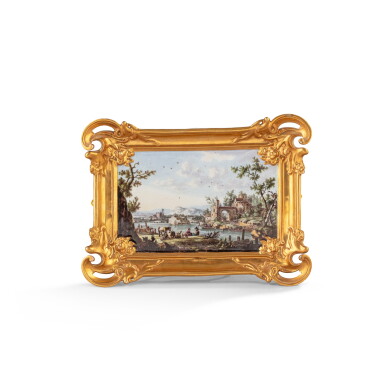
A Fürstenberg porcelain rectangular wall plaque, circa 1765-70
Estimate
800 - 1,200 EUR
We may charge or debit your saved payment method subject to the terms set out in our Conditions of Business for Buyers.
Read more.Lot Details
Description
painted in the manner of Pascha Johann Friedrich Weitsch, with a pastoral scene of a shepherd and companion seated by a river, with cows and sheep nearby and a boat on the river and buildings on the far bank, within an integral moulded and pierced gilt frame with rocaille scrolls at each corner, the reverse with four apertures for suspension, script F mark in underglaze-blue to back of frame, the reverse with incised F and s below
20.2 by 14.8 cm; 8 by 5 ⅞ in
Christie’s, Geneva, 12 November 1984, lot 38.
For a discussion of Fürstenberg plaques, see Manfred Meinz, 'Die Tableaus der Fürstenberger Porzellan-Manufaktur', Keramos, no. 162, October 1998, pp. 15-70. See also Siegfried Ducret, Fürstenberger Porzellan, Band II, Braunschweig, 1965, p. 101, pl. 92, for a plaque of a slightly different form in the Kestner Museum, Hanover, with a very similar landscape and p. 77 for discussion of painting in the style of Weitsch.
Pascha Johann Friedrich Weitsch (1723–1803) was among the most accomplished decorators associated with the early years of the Fürstenberg porcelain manufactory. Trained as a painter and engraver, Weitsch brought an unusually refined artistic sensibility to porcelain decoration, excelling particularly in finely painted landscapes, harbour scenes, and pastoral subjects inspired by Dutch and French models.
You May Also Like