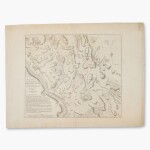
Gascoigne, John and William Faden | An important sea-chart of the South Carolina Sea Islands, made during the Revolutionary War
Lot closes
June 25, 07:00 PM GMT
Estimate
2,000 - 3,000 USD
Starting Bid
1,800 USD
We may charge or debit your saved payment method subject to the terms set out in our Conditions of Business for Buyers.
Read more.Lot Details
Description
Gascoigne, John and William Faden
A Plan of the River and Sound of D'Awfoskee, in South Carolina, Survey'd by Captain John Gascoigne. London: [1776]
Engraved map (545 x 755 mm). Edges browned, upper right corner lightly foxed, with restorations to margins and center fold, verso with minor spotting and soiling.
Highly important sea-chart of the South Carolina Sea Islands in its first state, made during the Revolutionary War.
The South Carolina Sea Islands, featured exclusively within this sea-chart, not only convey cartographical needs during the early periods of the Revolutionary War but relay the coastal region's importance. In 1729, Captain John Gascoigne and his brother James made detailed surveys of Port Royal Harbor (see lot 361) and the D'awfoskee (Daufuskie) Sound, now known today as the Calibogue Sound. The original manuscript made aboard the HMS Alborough was then copied and altered by Francis Swaine. By unknown means, the Swaine manuscript or a similar copy of Gascoigne's work made its way to William Faden, geographer to King George III.
As one of the most accurate depictions of Trench's Island (Hilton Head), D'awfoskee (Daufuskie) Island, St. Helena, and the mainland town of Beaufort, the 1776 printing would provide real strategic value—the area would become a hotbed for naval activity from both British and American forces during a skirmish off Hilton Head and the Battle of Beaufort in 1779. Hilton Head's harbors had been a continued area of activity since its early colonial encounters by the Spanish, French, English and even pirate visitors.
REFERENCES
Cf. Cumming, British Maps of Colonial America, pp. 47-49 and The Southeast in Early Maps, 204; Sellers & Van Ee, Maps & Charts of North America & the West Indies, 1525; Stevens & Tree, "Comparative Cartography," in Tooley, The Mapping of America, 16 (a)
You May Also Like