
Bauche, Philippe | Western Canada and the Great Lakes, featuring an uncommon example of indigenous cartography, 1754
Lot closes
June 25, 06:51 PM GMT
Estimate
6,000 - 8,000 USD
Starting Bid
4,200 USD
We may charge or debit your saved payment method subject to the terms set out in our Conditions of Business for Buyers.
Read more.Lot Details
Description
Bauche, Philippe
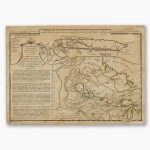
Carte Physique des Terreins les plus élevés de la Partie Occidentale du Canada. [Paris:] Publiée sous le Privilege de l'Académie des Sciences, 4 Septembre, 1754
Engraved map (250 x 357 mm). Partly hand-colored in outline, signed to the plate "Delahaye l'Aine sculpsit"; lightly toned, some pale staining, laid down on linen, short marginal tears, pin holes in margins, a small loss to the lower left corner affecting the "D" in Delahaye.
Bauche's unusual map displays two distinct theories about the geography of the then uncharted lands in Canada to the west of Lake Superior, one based on an indigenous source and the other from western sources. As such, it contains an uncommon example of indigenous cartography on a printed map. It is also notable for its representation of the Upper Midwest and Plains, three of the Great Lakes, and its inclusion of the spurious "Mer de l'Ouest."
Both are centered around a supposed waterway that connects Lake Superior to the Mer de l'Ouest. The smaller, less detailed map at the top of the sheet purports to be a copy after a map made by a Cree Indian, Ochagach, for a French officer in 1728. It shows a series of lakes connected by rivers and provides information about where to exit the river for portages. The map underneath is drawn from three different sources, all French. It covers a larger area in far greater detail. To the left of this map is a cartouche containing a sizeable text that points out some of the inconsistencies between the two maps, and cites some of the sources for the French map's geographical information. Taken together, Bauche's map is emblematic of the problems that European cartographers faced when trying to accurately map the North American frontier sight unseen, choosing between various uncertain sources, and building on unstable foundations in their attempts to prove a hypotheses or fill in a blank space.
This map was published in Bauche's major work on the geography of the Pacific Northwest, Considérations Géographiques et Physiques Sur Les Nouvelles Découvertes au Nord de la Grand Mer (1753–55). Only seven copies of the atlas have appeared at auction in the past 100 years, and this is the only separate copy of the map to have appeared at auction, per Rare Book Hub.
You May Also Like
![[Pennsylvania Hospital] — Montgomery & Winters | The first state of this early view of the nation's first chartered hospital, likely a unique impression](https://sothebys-md.brightspotcdn.com/dims4/default/e5cd88a/2147483647/strip/true/crop/2000x1578+0+0/resize/150x118!/quality/90/?url=http%3A%2F%2Fsothebys-brightspot.s3.amazonaws.com%2Fmedia-desk%2Fwebnative%2Fimages%2F64%2Fea%2F6b02433542a68124dbd3903eb167%2Fn12185-d5wrx-t3-02.jpg)