A Learning Ecosystem: Property to Benefit LA ESCUELA___
Sheroanawe Hakihiiwe
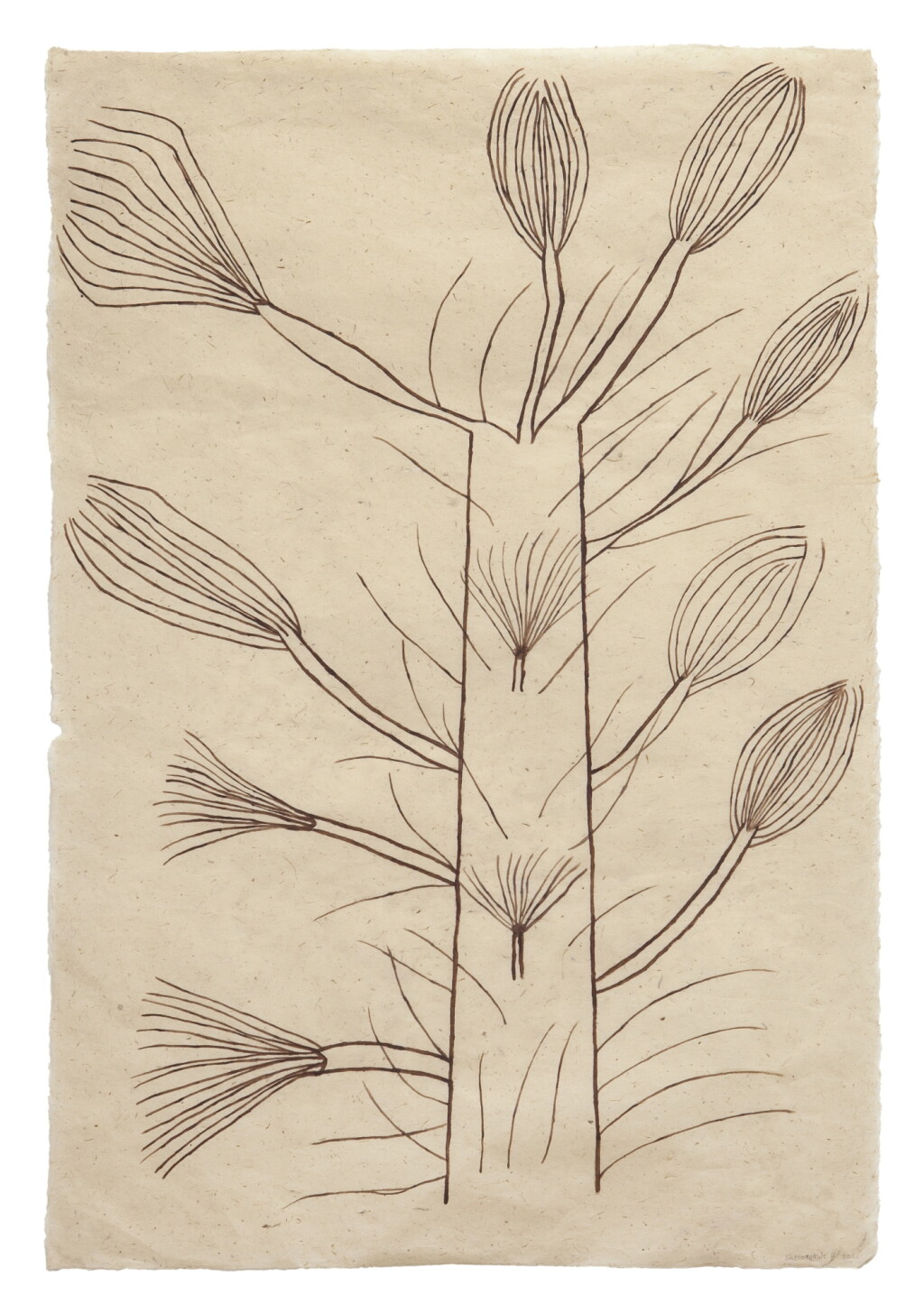
Hii Hi Henaki Kuami XI (Leafless Tree / Árbol sin hojas)
Lot closes
October 8, 04:58 PM GMT
Estimate
15,000 - 25,000 USD
Starting Bid
13,000 USD
We may charge or debit your saved payment method subject to the terms set out in our Conditions of Business for Buyers.
Read more.Lot Details
Description
A Learning Ecosystem: Property to Benefit LA ESCUELA___
Sheroanawe Hakihiiwe
b. 1971
Hii Hi Henaki Kuami XI (Leafless Tree / Árbol sin hojas)
signed and dated 2021 (lower right)
acrylic on paper
36 ⅝ by 24 ⅝ in.
93 by 62.5 cm.
Executed in 2021.
Courtesy the artist + Abra
Sheroanawe Hakihiiwe (Sheroana, Venezuela, 1971) is a Yanomami Indigenous artist residing in Platanal, a community in the Upper Orinoco River, near Mahekoto-Teri. Since the 1990s, Hakihiiwe has been developing a visual language that traces and commemorates the oral memory of his people, their landscapes, cosmogonies, and ancestral traditions. His paintings, monotypes, and drawings center on recurring themes and visual motifs inspired by his ancestral knowledge of the signs and symbols of Yanomami culture, and their application in basketry and body painting for ritual ceremonies. He employs a distinctive minimalist iconography, a language created with straight lines, organic curves, dots, circles, triangles, zigzags, arches, and crosses, evoking Amazonian animals and plants affected by the climate crisis. Hakihiiwe represents diverse aspects of Yanomami life, incorporating details of the jungle in each symbolic mark and gesture, and challenges binary oppositions: human-animal, life-death, body-spirit, and inside-outside.
His work has been widely exhibited internationally, including his participation in The Milk of Dreams at the 59th Venice Biennale (2022), Exposition Générale at the Fondation Cartier pour l’art contemporain, Paris (2025–26), and Wayamou: Common Tongues at Museo Tamayo Arte Contemporáneo, Mexico City (2026). He has also presented solo exhibitions at the São Paulo Museum of Art (MASP, 2023) and the Museum of Contemporary Art of Santiago de Chile (2025). Hakihiiwe’s works are part of private and public collections, such as Museo Reina Sofía, MoMA, Guggenheim Museum in New York, the British Museum, Museo de Arte de Lima, Museo de Arte Latinoamericano de Buenos Aires, Denver Art Museum, S.M.A.K Museum, Art Gallery of New South Wales, Fondation Cartier pour l’art contemporain, Museo de Arte de São Paulo (MASP); as well as the Patricia Phelps de Cisneros Collection, the Il posto Collection in Chile, the Catherine Petitgas Collection, among others.
A school without walls
LA ESCUELA___ began in 2021 with a reflection from its artistic director and co-founder, Miguel Braceli, about educational models for social practices and situated learning. This idea of bringing art and education closer to social realities by taking them out into public space became the building block of a project co-developed with the international foundation Siemens Stiftung. From this vision, LA ESCUELA___ was conceived as a “school without walls.”
Rather than operating from a fixed campus or following a predetermined curriculum, this artist-run platform works through a growing hemispheric network of artists, architects, educators, researchers, organizers, independent spaces, and communities. Its projects take shape in different contexts across the Americas, responding to local conditions while creating connections between places and practices.
Since 2022, LA ESCUELA___ has developed more than 45 projects in 13 countries, engaging more than 6,000 participants in online and on-site programs, and collaborating with over 350 artists and thinkers. Its programs include on-site experimental classrooms and online labs, residencies, public art, exhibitions, lectures, workshops, symposia, and research processes. An open-access Library with over 300 essays, interviews, documentation, and pedagogical resources expands this work into a growing alternative critical pensum of Latin American artistic and pedagogical practices.
At the heart of the platform is a commitment to reciprocal exchange: not exporting a model from one place to another, but creating conditions for different forms of knowledge to meet, circulate, and transform one another.
You May Also Like