A Learning Ecosystem: Property to Benefit LA ESCUELA___
Rufino Tamayo
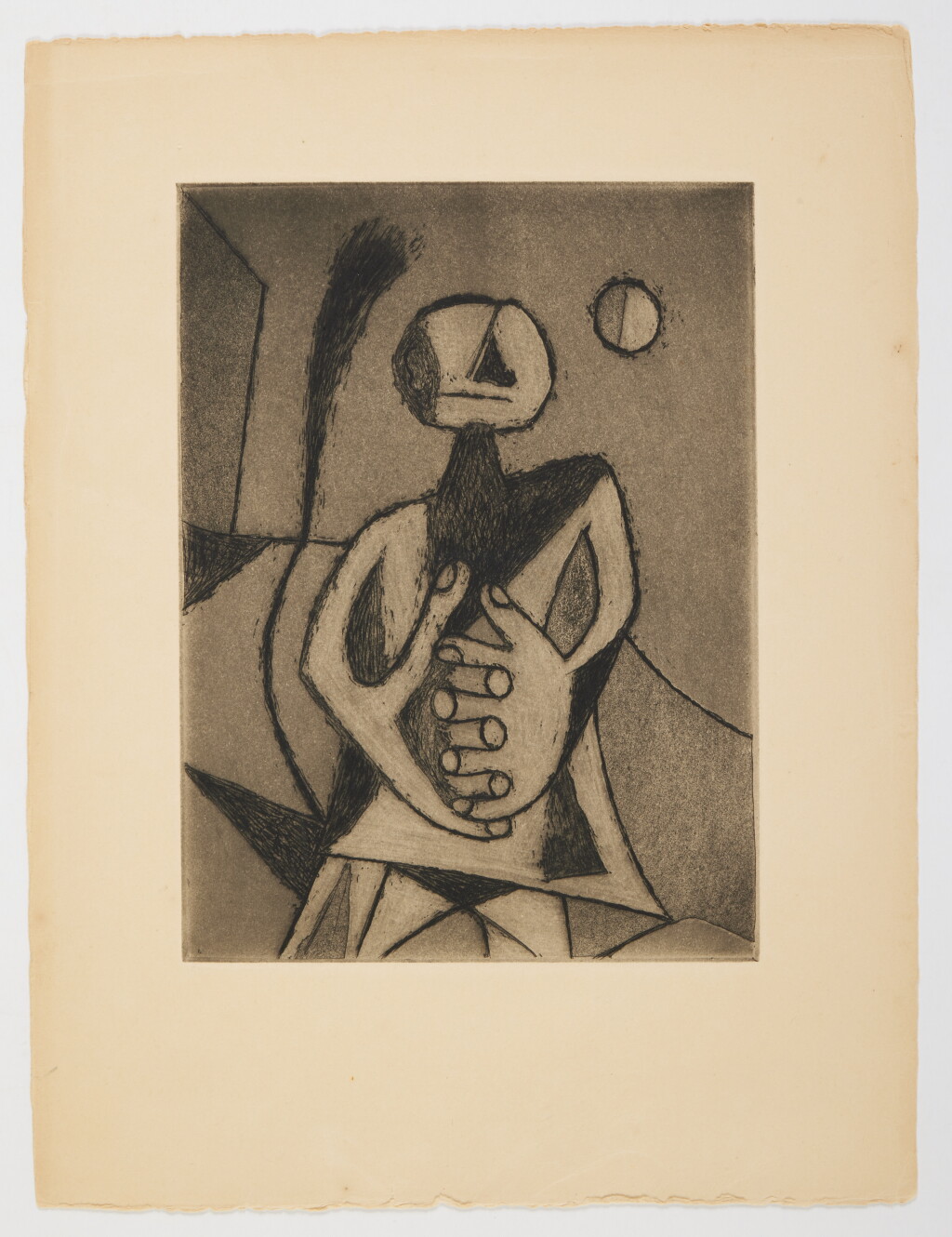
Hombre contemplando la luna
No reserve
Lot closes
October 8, 05:04 PM GMT
Estimate
1,500 - 2,000 USD
Current Bid
500 USD
8 Bids
No reserve
We may charge or debit your saved payment method subject to the terms set out in our Conditions of Business for Buyers.
Read more.Lot Details
Description
A Learning Ecosystem: Property to Benefit LA ESCUELA___
Rufino Tamayo
1899 - 1991
Hombre contemplando la luna
etching and aquatint on wove paper
plate: 7 ⅞ by 5 ⅞ in. 200 by 148 mm.
sheet: 12 by 9 in. 303 by 229 mm.
Executed in 1947, this impression is 0ne of five unsigned hors commerce impressions aside from the numbered edition of 80, published by the Quadrangle Press
Courtesy the Colección Patricia Phelps de Cisneros
Rufino Tamayo (b. 1899, Oaxaca, Mexico – 1991, Mexico City) was a painter, muralist, designer, sculptor, and printmaker of Zapotec heritage. He was a leading figure in Mexican and Latin American modern art during the 20th century. Over a career spanning more than seven decades, he developed a distinctive pictorial language that brought together references to pre-Hispanic art and Mexican culture with the transformations of international modernism. His engagement with the pre-Hispanic collections of Mexico’s National Museum played an important role in shaping a visual sensibility that would remain present throughout his career. During his years in New York, particularly between 1936 and 1950, Rufino Tamayo came into direct contact with international avant-garde movements and developed a visual language in dialogue with European modernism. His paintings combined these influences with colors, forms, and references drawn from Mexico and Mesoamerican cultures, creating his own approach to figuration and abstraction. Tamayo developed his career alongside Mexican Muralism, while maintaining an independent position toward the political and didactic character that defined much of the movement. His interests centered instead on the universal possibilities of painting and themes related to the human condition, nature, and the cosmos. In addition to easel painting, Tamayo created major monumental works, including a mural for UNESCO headquarters in Paris in 1958. His legacy is also closely associated with the Museo de Arte Prehispánico Rufino Tamayo in Oaxaca and the Museo Tamayo Arte Contemporáneo in Mexico City. Rufino Tamayo’s artworks are held in major international collections, including those of the Museum of Modern Art (MoMA), Solomon R. Guggenheim Museum, Smithsonian American Art Museum, and Art Institute of Chicago. His ability to establish a dialogue between Mexico’s cultural heritage and international modern art consolidated his place as an essential figure in 20th-century Mexican and Latin American art.
A school without walls
LA ESCUELA___ began in 2021 with a reflection from its artistic director and co-founder, Miguel Braceli, about educational models for social practices and situated learning. This idea of bringing art and education closer to social realities by taking them out into public space became the building block of a project co-developed with the international foundation Siemens Stiftung. From this vision, LA ESCUELA___ was conceived as a “school without walls.”
Rather than operating from a fixed campus or following a predetermined curriculum, this artist-run platform works through a growing hemispheric network of artists, architects, educators, researchers, organizers, independent spaces, and communities. Its projects take shape in different contexts across the Americas, responding to local conditions while creating connections between places and practices.
Since 2022, LA ESCUELA___ has developed more than 45 projects in 13 countries, engaging more than 6,000 participants in online and on-site programs, and collaborating with over 350 artists and thinkers. Its programs include on-site experimental classrooms and online labs, residencies, public art, exhibitions, lectures, workshops, symposia, and research processes. An open-access Library with over 300 essays, interviews, documentation, and pedagogical resources expands this work into a growing alternative critical pensum of Latin American artistic and pedagogical practices.
At the heart of the platform is a commitment to reciprocal exchange: not exporting a model from one place to another, but creating conditions for different forms of knowledge to meet, circulate, and transform one another.
You May Also Like