
Property from a Distinguished Philadelphia Collection
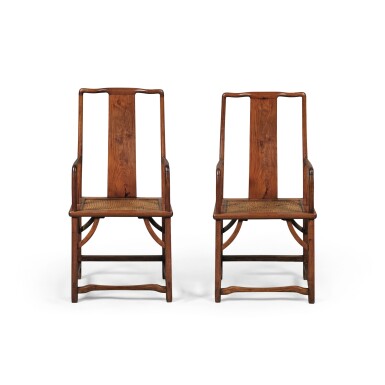
A very rare pair of 'huanghuali' 'Southern Official's Hat' armchairs (Nanguanmaoyi), Qing dynasty, Kangxi period
Live auction begins on:
September 16, 01:00 PM GMT
Estimate
150,000 - 250,000 USD
Lot Details
Description
(2)
Height 45 in., 114.3 cm; width 22 in., 55.9 cm; depth 19½ in., 49.5 cm
Sotheby's New York, 25th April 1987, lot 521.
Sotheby's New York, 22nd March 2001, lot 148.
The present pair of chairs is distinguished by its construction, with curved braces in place of the more typical aprons and spandrels. Most commonly found on rectangular or square tables and known as ‘giant’s arms’, such braces provide support in place of more conventional humpback stretchers. In the case of the present chairs, these braces provide a similar function and appear to be an idiosyncratic decision on the part of the artisan or the patron who commissioned them. The idiosyncrasy of the craftsman can also be found in the design of the footrest and side stretchers, which have an undulating curve similar to that of a humpback stretcher. Well worn from constant use, these ‘humpback’ footrests appear to be original to the construction. At this time, no other examples with this exact construction are known. A group of huanghuali yokeback armchairs with cabriole legs, including one sold at Christie’s Hong Kong, 30th October 2025, lot 1081 and another illustrated by Nancy Berliner in Beyond the Screen: Chinese Furniture of the 16th and 17th Centuries, Boston, 1996, p. 106-109, no. 9, are reinforced by braces, as the design of the legs would not be conducive to stretchers. A pair of large Dali-stone-inset huanghuali chairs, one originally in the Tseng Collection and sold at Christie’s Hong Kong, 29th November 2022, lot 2811, and the other in the collection of the Nelson-Atkins Museum, also has ‘giant’s arm’ braces, but these are angled diagonally from the inside of the leg to the underside of the seat frame, in contrast to the present example, which are perpendicular to the leg and frame.
From the seat frame upwards, the present pair of chairs follow the conventional design of continuous yokeback chairs, known by furniture connoisseurs in China as ‘Southern Official’s Hat’ armchairs (Nanguanmaoyi). Such chairs are characterized by the unbroken line from top and side rails to arms and legs, a feature that was made possible through the ingenious right-angle ‘pipe joint’. This specific form has emerged as one of the most desirable forms of yokeback armchair to survive from the Ming period; its slender members curving subtly to greet the sitter and its broad backsplat quietly declaring the opulence of its owner. Chairs of this design appear to have been associated with the ruling elite from their conception with miniature versions of this form preserved among the final possessions of leading Ming officials including Pan Yunzheng, whose model chairs were illustrated by Nancy Berliner in Beyond the Screen. Chinese Furniture of the 16th and 17th Centuries, Museum of Fine Arts, Boston, 2000, pl. 30i.
You May Also Like


