
Property from a Distinguished North American Private Collection
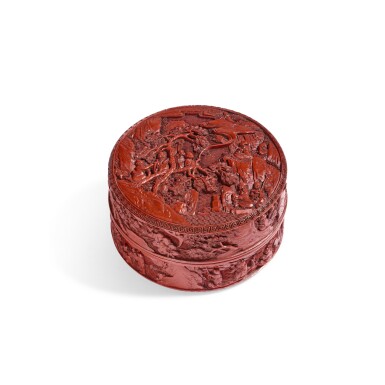
A rare carved cinnabar lacquer 'immortals' box and cover, Qing dynasty, Qianlong period
Live auction begins on:
September 16, 01:00 PM GMT
Estimate
80,000 - 120,000 USD
Lot Details
Description
(2)
Diameter 5½ in., 14.1 cm
Collection of John F. Triepel (1899-1985).
Collection of Sidonie Triepel (1933-2024).
The present box is remarkable in the quality of its carved designs which spill over onto the sides and even the bottom of the box with the same vigor and quality. Employing the full range of techniques and relief-work available to an imperial lacquer-worker — from a finely incised ground, sea and sky to expressive faces and billowing clouds — the box is a triumph of eighteenth century workmanship and a truly three-dimensional object. Unlike most lacquer boxes of the period constructed with a softwood or bamboo core, the lacquer design of the present box has been applied to a pewter base. This provides a relatively stable base for lacquered designs compared with the more sensitive wooden cores and affords the box a sense of weight, significance and majesty quite incomparable to wood-based examples of this size.
These painstakingly-worked designs are also striking in their auspicious imagery that ties the beholder to millennia of Chinese folklore and religion. From the Daoist scene on one face to the Buddhist scene on the other, the present box represents a microcosm of the history of Chinese thought, continuing onto the sides with famous Daoist tales of immortals. In this sense, closing the lid of the present box becomes more than a mere practical action and is imbued with cosmological significance. Echoing the philosophy of Ming scholar Wang Yangming (1472-1529), the box highlights that Ultimate Wisdom is found in the meeting of all schools of Chinese thought – each clarifying different laws of the universe, brought together here in the palm of one’s hand.
The cover of the box features a scene of Arhats Worshipping the Buddha (luohan li fo) amidst a vibrant landscape of rugged mountains, sea and sky, rendered in five different brocade patterns. Each of the eight arhats are carved with extraordinary individuality in facial expression and distinguished by their attributes: the Long-Eyebrowed Arhat (Asita) in the lower right, in front of another leaning on his staff holding a sutra; the Thinking Arhat (Rahula) and Happy Arhat (Kanakavatsa) above; the Tiger-Taming Arhat (Bintoulu) and Plantain Arhat (Vanavasa) to the left of the pine tree and the Elephant-Riding Arhat (Kalika) and another to its right. Emerging from the latter’s bottle in a magnificent cloud is the Buddha himself, who draws the eyes of the arhats and, in turn, the viewer in devotion.
Similarly skillfully rendered is the opposing scene of the Five Elders Observing the Tai Chi (wu lao guan Taiji), derived from the Daoist tradition. With two elders holding staffs, another two displaying the diagram and another pointing at it, this vibrant scene is dreamed with a lush landscape of cypresses, maples, reeds and pines evoking a transcendent realm, embodying – as the Tai Chi diagram itself does – the harmony of all things and the eternal law of balance. These two main scenes are particularly noteworthy in their featuring of nine and five figures respectively — two particularly important numbers in imperial craftsmanship which seem to signify the noble status of the Qianlong Emperor in the most subtle of ways, imbuing every corner of the present box with imperial grandeur.
Similarly magnificent are the twelve further Daoist scenes adorning the sides of the box and cover, containing another twenty-four figures representing blessings of longevity, harmony and unity. These vibrant scenes, each rendered with the same remarkable level of intricate detail include the following on the sides of the cover: Hanshan and Shide; Chen and Lü Discussing Taoism; Turning Stones into Sheep; Liu and Ruan Encountering Immortals; Qin Gao Riding a Carp; and Zhongli Entering Taoism. The sides of the body of the box further depict: The King of Chaos Riding a Phoenix; Crossing the River on a Reed; Zhang Lu Debating Alchemy; The Two Immortals of Harmony (Hehe Erxian); Magu Riding a Carp; and Peng Zu Wishing for Longevity.
Comparable boxes of this size, quality and multi-sided nature are rare. A box of similar size and side decoration of Qianlong mark and period is inscribed with the title Baizi baohe and adorned with a design of myriad boys worked in a very closely related fashion to the present, illustrated in Complete Collection of Treasures of the Palace Museum. Lacquer Wares of the Qing Dynasty, Hong Kong, 2006, pl. 10. Compare also a closely related box depicting the luohan on one side and scholars playing chess on the other sold in our Hong Kong rooms, 9th October 2007, lot 1646; and another depicting the Eight Immortals and Xiwangmu on one side and a scholars’ feast on the other, sold at Christie’s Hong Kong, 29th May 2009, lot 1846.
You May Also Like


