
Property from a California Private Collection
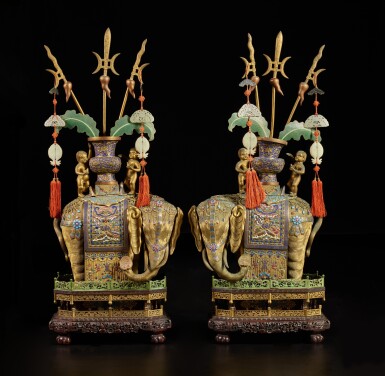
A pair of gilt-bronze and cloisonné enamel elephants, Qing dynasty, 18th / 19th century
Live auction begins on:
September 16, 01:00 PM GMT
Estimate
40,000 - 60,000 USD
Lot Details
Description
later-added gilt-metal wood stands with apocryphal Qianlong marks (18)
Height 19⅛ in., 48.5 cm
Collection of Alice (1906-1984) and Harry (1895-1969) Shabas, acquired in China between 1925 and 1946.
Elaborately modeled in the form of an elephant carrying a vase, the present pair is remarkable for its brilliant combination of gilt-bronze and cloisonné enamels. Figures of elephants carrying vases were usually made in pairs and often displayed in throne rooms where they functioned as auspicious omens. The elephant (xiang) is a symbol of peace and with a vase (ping), it forms the wish taiping youxiang (peaceful times).
Compare an elephant and vase group in the collection of the Summer Palace, illustrated in Zhongguo meishu fenlei quanji. Zhongguo jinyin boli falang qi quanji [Complete Book of Gold and Silver Wares, Glass Wares and Cloisonné Enamels Volume], Shijiazhuang, 2002, vol. 6, pl. 281.
Alice (1906–1984) and Harry (1895–1969) Shabas resided in Tianjin between 1925 and 1946, a period during which Harry managed the American rug factory of A. & M. Karagheusian. Renowned for its celebrated Imperial Pagoda carpets, the company was among the very few manufacturers producing thick-piled Chinese oriental rugs for an international market. Living in one of Republican China’s foremost commercial and cultural centers, Alice and Harry Shabas developed a deep appreciation for Chinese art and collected extensively during their two decades in the city.
You May Also Like


